|
The Highways Department has recently revised its Code of Practice for the Signing, Lighting & Guarding of Roadworks, introducing three new special temporary warning signs and plastic pedestrian barriers to boost road safety.
The department's Senior Engineer Nip Chi-kwong told news.gov.hk the code was formulated almost 30 years ago, providing a standard of good practice for marking road works and the necessary temporary traffic-control measures.
|
|
| Safer guards: Highways Department Senior Engineer Nip Chi-kwong says plastic barriers and new special temporary warning signs have been introduced to boost traffic safety. | |
Local characteristics
"We have been paying close attention to local and overseas developments in lighting, signing and guarding facilities. When reviewing and updating the code, our prerequisite is to bolster the safety of both pedestrians and drivers. We will make reference to the latest international standards and take into account Hong Kong's unique characteristics to ensure these standards suit the local situation," Mr Nip said.
The code was first updated in 1984, with the second revision in 1996. The updates were made in view of traffic safety and public suggestions.
The latest revision, gazetted last December, came into effect on July 1, and involved four key aspects.
"Road works should be adequately guarded at all times for the safety of pedestrians and drivers. Hard objects, such as metal poles, may pose a serious hazard should a vehicle collide with them," said Mr Nip.
Plastic barriers
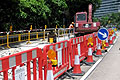
"In this regard, the code has been revised, requiring pedestrian barriers placed on carriageways adjacent to running traffic lanes be made of plastic and guarded by traffic cones.
"Many overseas countries have deployed plastic pedestrian barriers, which are as durable as metal ones and will not rust."
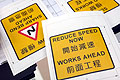
On larger-scale road works, three new special temporary warning signs have been introduced to arouse drivers' awareness.
The new signs carry black borders and legends - "SLOW, ROAD WORKS", "REDUCED SPEED, WORKS AHEAD" and "SLOW, SHARP BEND AHEAD" - on an eye-catching yellow background. Their sizes range from 1.2 - 2.1 metres in height and 1.2 - 1.8 metres in width.
New warnings
Mr Nip said these warning signs will be required when one or more of the following criteria are encountered:
* works involvediversion of traffic away from the original carriageway to a temporary pavement through a work site;
* works involve temporary complete closure of a section of carriageway; or
* road-construction projects involve fencing off one or more traffic lanes longer than 100 metres and the project period is one month or more.
The "SLOW, ROAD WORKS" sign will be placed at the beginning of a work zone, and to be added intermittently at appropriate locations if the fenced-off area is longer than 135 metres.
The "REDUCED SPEED, WORKS AHEAD" sign will be erected at 100 metres ahead of the "SLOW, ROAD WORKS" sign. The "SLOW, SHARP BEND AHEAD" sign will be put up 100 metres ahead of the sharp bend sign when temporary traffic arrangements involve sharp bends.
Clearer signs
To ensure temporary directional and other worded signs are clear and proper, new conditions have been added to the code, requiring such signs to comply with the Transport Planning & Design Manual, including the size, colour and letter size.
On comments that the flashing arrow sign is too dazzling sometimes, Mr Nip said the code has been updated to govern the sign's luminous intensity.
"The sign should have variable luminous intensity and be visible at night and in day conditions. Its luminance performance should be regularly monitored to ensure it complies with the requirements," he added.
Since the revised code was gazetted last December, the department organised seminars for public utility companies and contractors to update them of the new requirements, which came into effect early this month. Mr Nip said public-utility companies and contractors should have sufficient time to prepare for the changes.
Go To Top
|