|
The life-saving rescue operations of frontline fire-fighters and ambulance men would not be as prompt without the contribution of the heroes behind the scenes - the officers of Fire Services Department Mobilising & Communications Group.
Wearing dark blue uniforms, they oversee the Fire Services Communication Centre (FSCC).
Principal Fireman (Control) Lee Cho-tak said their main duties are to handle complaints and enquiries regarding fire safety, receive emergency calls and dispatch fire and ambulance resources in fire-fighting and rescue operations.
They manage 5,000 calls on fires and special services per month, along with 53,000 for ambulance services.
|
|
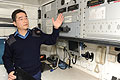
In command: Principal Fireman (Control) Lee Cho-tak introduces the Fire Services Communication Centre and mobile command unit. |


|
Accurate dispatch
Time can mean the difference between life or death in emergencies. FSCC officers obtain important information from callers to dispatch the most appropriate resources in the shortest time possible.
"Once we receive a call we need to confirm the address and nature of the incident, patient or casualty information, scene safety, as well as the caller's details. We enter the data in the mobilising system and dispatch fire-fighting and ambulance resources. The whole process takes less than one minute," Mr Lee said.
After dispatching resources they take follow-up action and monitor the latest information, such as the number of casualties and people evacuated. Messages are passed to officers in charge to facilitate co-ordination with other units and departments.
Challenging work
To achieve target response times of six and 12 minutes in 92.5% of fire and emergency ambulance calls, there is no room to delay resource allocation.
"As every call can mean life or death, we have to be very familiar with the dispatching system and procedures, aware of the resources on hand and take each call seriously," Mr Lee said.
Working at the communication centre for 15 years, Mr Lee said the job is challenging as he must prioritise work and make decisions in seconds, adding he gets great job satisfaction from helping citizens.
He said FSCC officers should be prudent, able to work under pressure, and possess strong logical thinking and problem-solving ability. They undergo three months' initial training in first-aid, the use of fire extinguishers, marching and other knowledge.
Mobile centre
During major incidents like number-three alarm fires or above, FSCC will deploy a Mobile Command Unit to the scene. It serves as the co-ordinator between officers in charge and the communication centre.
"The mobile unit acts as an on-scene command and control centre in major incidents. We monitor all radio and television channels, and collect, compile and disseminate information to the Fire Services Communication Centres. They then take appropriate follow-up action," he said.
There are four crewmembers working on the Mobile Command Unit. Their division of work must be clear and precise as they need to collaborate closely.
The Station Officer (Control) prepares information for the officer in charge for strategic deployment, while the Principal Fireman (Control) is responsible for monitoring radio and television channel messages. Two Senior Firemen (Control) need to confirm resource distribution at the scene.
Currently, there are five Mobile Command Units posted at Sheung Wan, Tsim Sha Tsui, Sha Tin, Lai King and Tung Chung Fire Station.
New system
The Fire Services Department will implement a medical priority dispatch system in the next few years to enhance working efficiency and service quality.
Emergency ambulance calls will be categorised according to the degree of urgency. The response time target for life-threatening cases will be reduced from 12 minutes to nine.
Mr Lee said after the implementation of the system the existing combined mode of the mobilising system will be replaced by a separate one, making call-takers responsible for giving post-dispatch and pre-arrival instructions. The call will be sent to a dispatcher for ambulance deployment.
He added the move will ensure the most valuable resources are allocated to emergency cases, giving the public the most efficient service.
Go To Top
|