|
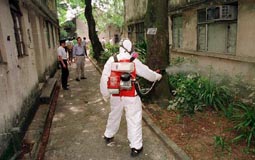
Since the outbreak of Dengue fever in September 2002, the Government has been taking all possible measures to eliminate mosquito breeding grounds. To sustain these efforts, the public should actively take part in the Anti-mosquito Campaign and remain vigilant against Dengue fever despite the cooler weather.
Making the appeal, Food & Environmental Hygiene Department Consultant Dr Ho Yuk-yin says the Ovitrap Index, which measures the number of mosquitoes and their species, dropped from 14.6% in October to 5.3% in November. The latest figure indicates that Aedes albopictus, the Dengue carrier, is no longer active in Hong Kong.
Dr Ho urged the public to take the opportunity to eradicate all possible breeding grounds for Aedes albopictus and destroy Aedes eggs before the next rainy season.
Aedes albopictus eggs can survive the dry winter and hatch under more favourable conditions, so the present cooler weather should not slow the anti-mosquito drive.
"We must keep up our efforts in vector prevention and control measures. It is crucial that all members of the public should pitch in and play an active role in combating the mosquito problem," he added.
Dr Ho suggested that when members of the public do their traditional clean-up before the Lunar New Year, they should pay particular attention to small containers such as vases, saucers, trays and damp surfaces - all favourable places for Aedes albopictus to lay their eggs.
* People should also watch for Aedes eggs in trays under air-conditioning units and drainage systems.
* Water containers, vases and saucers should be scrubbed and cleaned with household detergent at least once a week
* Residents should keep all drains unclogged.
* Drains and surface drainage channels should be scrubbed and washed with alkaline detergent compound at least once a week.
* All holes and puddles must be topped up to prevent mosquito eggs from hatching in the rainy season.
Getting rid of stagnant water is also key to eliminating mosquito eggs.
Improperly managed construction sites are often favourable breeding grounds for mosquitoes, so stringent enforcement actions have been taken in construction sites under the department's Anti-mosquito Campaign.
Dr Ho stressed that the Government could not tackle the mosquito problem alone. Community participation is needed to help prevent future outbreaks of Dengue fever.
"The public are urged to report any mosquito breeding grounds to the FEHD's hotline at 2868 0000 so that prompt action can be taken," he said.
Go To Top
|