|
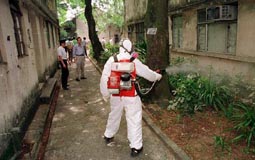
Pest control: A staff of the Food & Environmental Hygiene Department sprays pesticides at potential mosquito breeding places. |
As the wet season approaches, the Anti-mosquito Steering Committee urges the public to join hands with Government departments to fight mosquito breeding.
The Committee stresses that community participation is key to reducing the chance of a Dengue fever outbreak.
Before the end of the month, the Food & Environmental Hygiene Department will release details of 38 Area Ovitrap Indices, and a Monthly Ovitrap Index.
The Ovitrap Indices show how widespread the distribution of the Aedes Albopictus mosquito is in the areas surveyed. The monthly index gives the average of all Area indices for a month.
The Department will also set up a pilot ovitrap study covering upper floors of high-rise buildings in mid-2003. Its findings will help determine how best to prevent mosquito bites inside homes.
The Department of Health will continue to monitor local and imported Dengue fever cases through a statutory notification system and Hospital Authority reports.
Public hospitals have been reminded to send specimens to the Public Health Laboratory Centre for rapid diagnostic and confirmatory tests.
The Department promptly investigates each reported Dengue fever case through home visits and epidemiological surveys around patients' homes and workplaces.
To maintain a high level of public awareness of Dengue fever's risks and measures to prevent mosquito bites, new TV and radio announcements have been aired since December and more will come onstream in the next few months.
To get rid of all possible breeding grounds for Aedes albopictus and destroy their eggs, the public should take the steps outlined below.
* Scrub and clean edges and sides of water containers, vases and saucers with household detergent at least once a week.
* Keep all drains clear and unclogged. Drains and surface drainage channels should be scrubbed and limewashed with alkaline detergent compound, again at least once a week.
* Top up all depressions that might hold water to prevent eggs from hatching when the rainy weather returns.
* Remove stagnant water.
|
