 |
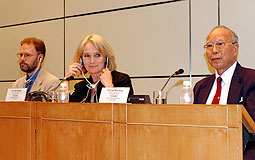
| Top job: The team of SARS experts studying the outbreak praise Hong Kong's efforts in handling the virus. |

|
A team of SARS experts has praised Hong Kong's efforts in handling the mystery outbreak.
Rounding up the SARS Expert Committee Public Health Group's five days of meetings and inspections in Hong Kong, Chairperson Professor Sian Griffiths said today the joint efforts of the Government, healthcare sector and academia were impressive.
"We are not here to judge, we are here to extract lessons to learn. But it is really important to start by making the point that there is much to praise in the way our public health and clinical colleagues have dealt with the outbreak. We were immensely impressed with the SARS database and the work of public health colleagues in the academic sector who worked together," Professor Griffiths said.
"[Also] the enormous trauma to healthcare staff may not be appreciated everywhere. People whose colleagues were actually affected [by the virus], and how they had to continue working. [And] the huge numbers of contract tracing that was done."
However, Professor Griffiths called on Hong Kong to improve cross-boundary communications and its surveillance systems on infectious disease.
"One of the things we feel quite strongly about is proactive communication with Guangdong. Public health is about protection and making sure things don't happen. And one of the things we would like [to see] a bit more is exchange of information across borders to ensure we are all as well informed as can be as soon as possible," she said.
"There are 300,000 people crossing the border everyday and communicable diseases don't respect geographical boundaries. There is a need for the sharing of surveillance. I understand the system in place at that time [of the outbreak] was one where information had to go from Guangdong to Beijing to Hong Kong, and what you really need is much closer liaison.
"[However] since the beginning of SARS, there has been a lot of progress. There is a need [now] to formalise this communication to make sure there is early warning. We need open sharing across all borders."
There was also a need to strengthen Hong Kong's surveillance system and awareness of public healthcare issues.
Professor Griffiths said the group will not draw up formal recommendations until it consolidates and further discusses its findings. Members will return to Hong Kong in August.
"There is much to learn not just for Hong Kong but for the international community in general. We hope to share the final report internationally. We have a lot of lessons to learn on how to handle a new disease. [We need to] look further at how to develop an effective contingency plan for dealing with an unknown disease."
Go To Top
|