|
An ambitious infrastructure-development agenda is expected to create about 250,000 jobs and boost the economy's added value by more than $100 billion annually, Chief Executive Donald Tsang says.
He opened his Policy Address today by outlining 10 major infrastructure projects with which Hong Kong will push ahead. The move aims to bring about "huge economic benefits", he said, adding both employment opportunities and wages will increase during the construction stage. "Upon completion, the infrastructure projects will boost economic activities and improve the living environment."
|
|
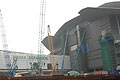
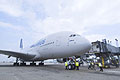
Meeting demand: The HK Convention & Exhibition Centre is undergoing expansion, while HK International Airport plans to hook up with Shenzhen Airport, via rail. | |
An ambitious infrastructure-development agenda is expected to create about 250,000 jobs and boost the economy's added value by more than $100 billion annually, Chief Executive Donald Tsang says.
He opened his Policy Address today by outlining 10 major infrastructure projects with which Hong Kong will push ahead. The move aims to bring about "huge economic benefits", he said, adding both employment opportunities and wages will increase during the construction stage. "Upon completion, the infrastructure projects will boost economic activities and improve the living environment."
The recently established Development Bureau will co-ordinate these projects, Mr Tsang said.
"These projects will not only expand the room necessary for Hong Kong's further development, but also improve our transportation, thereby linking up our socio-cultural and business activities with more efficient transportation systems.
"More importantly, with closer rail and road transport links between Hong Kong and the neighbouring regions of Shenzhen and the Pearl River Delta, we can foster further cross-boundary integration. These infrastructure developments will consolidate Hong Kong's status as a global city and lay a new foundation for our sustained development in the future."
Transport infrastructure enhanced
South Island Line: The local community has been demanding the mass transit railway's extension to Southern District, the Chief Executive noted. The Executive Council will examine an MTR Corporation proposal with a view to authorising it to proceed with engineering design. The seven-kilometre rail line's construction will start in 2011 and cost more than $7 billion, and the South Island Line will be commissioned no later than 2015.
"With the expected endorsement of the West Island Line, Hong Kong Island will have a much more extensive rail network," Mr Tsang said.
The Sha Tin to Central Link: This link will connect the Northeast New Territories and Hong Kong Island via East Kowloon. A detailed plan will be ready for public consultation early next year, and construction work is slated to start in 2010.
The Tuen Mun Western Bypass and Tuen Mun-Chek Lap Kok Link: The Government plans to develop this link at a cost of over $20 billion. Upon its completion in 2016, there will be a direct access linking up Deep Bay in Shenzhen, the Northwest New Territories and Hong Kong International Airport. This will benefit the logistics industries - and alleviate busy traffic along the North Lantau Highway.
Cross-boundary projects boost co-operation
The Guangzhou-Shenzhen-Hong Kong Express Rail Link: Our country is now building a 12,000km high-speed national rail network to link up major cities, with maximum train speeds of 200 to 300km an hour, Mr Tsang noted. This network will enhance the Mainland's transport capacity. The Government plans to press ahead with the Guangzhou-Shenzhen-Hong Kong Express Rail Link running from West Kowloon to Shibi, Guangzhou.
In Hong Kong, the link will use a dedicated line to ensure its smooth operation. The provision of a common immigration and customs clearance system for Hong Kong and the Mainland at the Kowloon Terminal is under study. The planning and design processes should be completed within next year, so that construction will commence in 2009, he added.
Hong Kong-Zhuhai-Macau Bridge: This strategic cross-boundary project is unprecedented in terms of scope, scale and complexity. The engineering feasibility studies for more than 20 project items are complete, and the three governments involved are working out the financial arrangements and an expert group will scrutinise the report before the project goes to the next stage.
The Government is consulting the public on a site selection for the boundary crossing facilities in Hong Kong.
Hong Kong-Shenzhen Airport Co-operation: For Hong Kong International Airport and Shenzhen Airport to complement each other, there are plans to establish a rail connection between the two. HKIA ranks among the world's busiest international airports in terms of both passengers and cargo, while Shenzhen Airport handles far more domestic flights than Hong Kong. The Shenzhen Municipal Government supports proposals on further co-operation between the two airports, and the two governments will form a joint task force. The Chief Executive hopes specific works plans can be ready early in 2008.
Hong Kong-Shenzhen Joint Development of the Lok Ma Chau Loop: Hong Kong and Shenzhen can achieve a win-win situation for both sides by adopting an integrated regional development strategy, the Chief Executive said.
"Apart from enhancing cross-boundary transport links, we will work with the Shenzhen authorities to tap the land resources of the Lok Ma Chau Loop to meet future development needs and consolidate the strategic position of Shenzhen and Hong Kong in the Pan-Pearl River Delta region," he said, adding the two sides will establish a high-level co-ordinating mechanism.
New urban development areas underway
West Kowloon Cultural District: The WKCD represents a major investment in cultural and arts infrastructure and a strategic plan to promote long-term development of arts and culture. It will offer a mix of world-class arts and cultural facilities, talented artists, quality programmes and distinctive architecture to attract people in Hong Kong as well as from the Mainland and the rest of the world, Mr Tsang said.
The Government will introduce the bill on establishing the WKCD Authority in early 2008 and aims to have the laws enacted in mid-2008 so the authority can be set up as soon as possible.
Kai Tak Development Plan: Statutory procedures to amend the Kai Tak Outline Zoning Plan are almost finished, after which the project will enter the implementation stage. Tenders will soon be invited to construct a new cruise terminal, and the first berth is expected to be operational in 2012.
New Development Areas (NDAs): These areas are planned to ease pressure on developed areas and to meet the demand for land arising from population growth. These areas will be smaller, less than a quarter of that of existing new towns such as Tuen Mun and Sha Tin. They will provide land for housing, employment, high value-added and non-polluting industries.
"Through comprehensive planning, the NDAs will provide quality living space and convenience to both residents and users. In this connection, we will revive planning and engineering studies on NDAs at Kwu Tung North, Fanling North, Ping Che and Ta Kwu Ling and Hung Shui Kiu, and work out implementation strategies," Mr Tsang said.
Convention business to be expanded, too
Apart from these 10 major projects, the Chief Executive also noted the Hong Kong Convention & Exhibition Centre's exhibition area will increase by 42% with the completion of the atrium link extension in 2009.
To cater for longer-term demand, AsiaWorld-Expo is considering the early commencement of its phase II expansion, which will increase its exhibition area to 100,000 square metres.
"We are also looking at providing additional convention and exhibition facilities in conjunction with the Trade Development Council. We will also gauge the need for land supply for hotel development," Mr Tsang said.
Go To Top
|