|
The Hong Kong Maritime Rescue Co-ordination Centre is one of the best facilities of its kind in the world.
Established in 1989, the Centre is responsible for co-ordinating all search and rescue missions in Hong Kong waters and major part of the South China Sea, covering an area of over 450,000 square nautical miles .
|
|
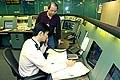
Marine manoeuvres: Equipped with advanced communication facilities, the Hong Kong Maritime Rescue Co-ordination Centre is able to handle search and rescue operations and co-ordinate all available resources, including Police launches and Government Flying Services aircraft. |

|
According to the Centre's head, Captain Ravi Dewan, whenever a call for help or a report of a maritime incident comes, it organises a search and rescue operation and co-ordinates all available resources.
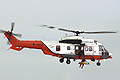
These include Government Flying Service aircraft, Marine Police launches, and Fire Services Department vessels and divers.
However, the Centre does not have direct command over these resources. Their respective Government departments operate them and they are only called for help when needed.
For search and rescue operations on the high seas, the Centre relies heavily on merchant vessels plying the area and GFS aircraft.
Before the Centre's inception, the former Port Control Centre handled search and rescue operations. The PCC was mainly responsible for regulating sea traffic in Hong Kong waters.
Typhoon Ellen, which wreaked havoc here in 1983, triggered the establishment of the Maritime Rescue Co-ordination Centre.
The typhoon caused many accidents in the harbour, including the sinking of a three-masted schooner named Osprey. Seven lives were lost and only one crew member was saved.
A marine court inquiry into the sinking criticised the PCC's part-time role and its inability to handle a complicated search and rescue operation. It recommended the establishment of an independent search and rescue centre.
The first step was to find qualified search-and-rescue trained officers, so it turned to the United States Coast Guard for help.
When a new Vessel Traffic Centre was set up in 1989 to replace the PCC, the new Maritime Rescue Co-ordination Centre took over the latter's office in the Rumsey Street Multi-storey Carpark Building in Central.
Initially, it was manned on a 24-hour basis only by an assistant officer. The duty search-and-rescue officer was on call.
"We then trained some more officers and by 1992, we eventually had a fully-manned centre with a qualified search-and-rescue trained Marine Officer, a Marine Inspector and a professional radio officer who operated the Global Maritime Distress Safety System radio equipment," Captain Dewan said.
Last year, the centre moved into its new office in the outer pier of the Macau Ferry Terminal in Central, next to the VTC. The new facility is equipped with the most advanced technology to communicate with ships and receive distress alert signals.
This new equipment includes the Search & Rescue Satellite Tracking System for detecting Emergency Position Indicating Radio Beacons, a Digital Selective Calling System, high-powered Radio Transceivers, Marine VHF, Inmarsat reception terminal and fax machines.
With direct lines to other local search-and-rescue agencies, the Maritime Rescue Co-ordination Centre also maintains a good working relationship with fellow centres throughout the region.
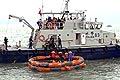
To hone its ability to respond in emergencies, the centre also holds annual search and rescue drills at sea which involve other Hong Kong agencies. Macau and Guangdong are also invited to participate in some of these exercises.
In recognition of Hong Kong's expertise in maritime search-and-rescue, the International Maritime Organisation has nominated it to be a member of the working group jointly operated by IMO and the International Civil Aviation Organisation to discuss the harmonisation of maritime and aeronautical search-and-rescue matters.
Being the longest serving officer in the centre, Captain Dewan feels lucky and privileged to have been able to save lives.
"Serving in the MRCC has been a very exciting and interesting experience as I have the chance to participate in the evolution of a rather basic search and rescue facility into a dynamic and effective organisation," he said.
"From inviting US experts to train our officers, to having our own training school and offering training to some of our Guangdong and Macau counterparts in recent years, it is evident that we have had a great advancement in maritime search-and-rescue matters."
Go To Top
|