 |
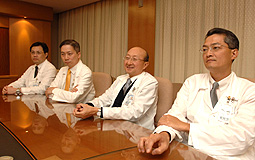
| Healing hands: (from left) Dr Chan See-ching, Professor Liu Chi-leung, Professor Fan Sheung-tat, and Professor Lo Chung-mau have been recognised for their innovative approach in refining the surgical technique of live donor liver transplant. |

|
A State Scientific & Technological Progress first-class award has been conferred on four local liver-transplant experts for their innovative approach in refining the live-donor, liver-transplant surgical technique.
This is the first time that local scientists have won a first-class award under the State Science & Technology Awards organised by the National Office of Science & Technology Awards.
More than 800 entries competed for the 2005 State Scientific & Technological Progress Award, which is given to scientists who have made outstanding contributions in the implementation of technology-development projects and social public-welfare projects.
The first-class award went to 18 projects.
National recognition key
Hong Kong's winning project, entitled "Adult-to-adult Right Lobe Live Donor Liver Transplantation", was carried out by Professor Fan Sheung-tat, Professor Lo Chung-mau, Professor Liu Chi-leung and Dr Chan See-ching of the University of Hong Kong's Department of Surgery.
Prof Lo said in the past local medical experts mainly focused on seeking international recognition and seldom competed for national awards.
"We are pleased that our efforts have been recognised by our country. Winning recognition from our own country is very important to our university," he said.
Liver transplantation is the most effective treatment for patients with terminal liver diseases but the application is limited because of the low organ-donation rate in Hong Kong.
The other possible source of liver grafts is from living people. Its application has been limited, though, because it was thought that a person could donate only a left lobe - which is generally too small for most adult recipients.
Led by Professor Fan, the group tried to extend the procedure to adult patients by using the larger right lobe.
"Many surgeons in other countries were reluctant to make such an attempt because the right-lobe, live-donor liver transplant would expose the donor to greater risks and the surgery would become more difficult," Prof Fan said.
Major breakthrough
"We pioneered an operation using the right-lobe liver graft in 1996. It was a major breakthrough because, for the first time, it overcame the problems of organ shortage in adult patients and graft-size limitation."
Over the years, the group has been refining the surgical technique. Modifications included strategies to reduce the donor's blood loss, and including the middle hepatic vein in the right-lobe graft to achieve optimum graft function and patient survival.
The modifications have greatly reduced the hospital death rate and contributed to the excellent outcome of transplant patients.
"The average amount of blood lost during the operations of donor has dropped from 800cc to about 200cc," Prof Fan said.
"The duration of operations of donors has been reduced from 10 hours to six hours while operations of recipients has been shortened from 23 hours to around 10 hours."
The refined surgical strategies have also shortened patient's stay in the intensive care unit from one week to just two to four days.
To date, about 200 right-lobe, live-donor liver transplants have been performed in adult patients at the University of Hong Kong.
"The recent survival rate is 95% while the overall figure since 1996 is 85%. Both are among the best in the world," Prof Fan said.
Innovative approach saves lives
Prof Lo said the innovative approach is particularly life- saving in Asia where organ donations from the deceased are scarce.
In Hong Kong, about 70% of liver transplants require a right-lobe, while in Japan, about 99% do.
The international medical field has also recognised the group's efforts and numerous liver-transplant centres around the world have adopted their approach to right-lobe, live-donor liver transplants.
Prof Liu said the research group bridges the gap between donors and recipients and helps both donors and recipients live happy and healthy lives.
Dr Chan stressed the group's role is to assist donors to help desperate liver patients. "Most of the credit should go to the donors. Their generous contribution has been a driving force for our research."
Go To Top
|