 |
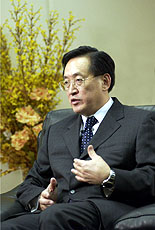
| Food, glorious food: Dr York Chow has two firm goals in his new role, to introduce licencing for private kitchens and to usher in nutrition labelling. |


|
After he had been in the role of Secretary for Health, Welfare & Food for about a month, news.gov.hk spoke with Dr York Chow. Since Hong Kong is a paradise for gourmets and gourmands, we put the focus on the third aspect of his role: food.
Dining out may well be Hong Kongers' favourite pastime. They are not starved for choice, either: At the end of September, the Food & Environmental Hygiene Department had issued 7,844 general restaurant licences and 2,875 light refreshment restaurant licences.
All these licensed establishments are subject to strict food hygiene regulations. Recently, though, there has been a rise in the popularity of private kitchens and upstairs cafes, which fall outside the scope of legislation.
Special licence to cover private kitchens due within two years
Asked whether there are plans to adjust the regulatory framework and amend the laws to clamp down on these eateries, Dr Chow said legislative amendments would be tabled to the Legislative Council this year, and he hoped the licensing system would be in place in a year or 18 months.
"We are mindful that some of these restaurants are situated not in a commercial building but in a residential building, which actually should be illegal," he said.
"We need to take actions against those that are definitely illegal. At the same time, we are looking at a way of licensing some of those small little family restaurants that have come into fashion nowadays, yet they need to comply with the building laws, the fire exit regulations, and for us, the hygienic, environment regulations as well."
He planned to introduce a special licence for the home kitchen type of restaurant. It would put a limitation on the number of diners, number of tables, and perhaps the operating hours.
"We'll be introducing that in this legislative year so that we will be able to perhaps give them a way of making a livelihood while satisfying the need of our consumers," Dr Chow said.
HK may be first in region with nutrition labelling laws
Another issue within his ambit is the pressure to introduce laws requiring nutrition labels, particularly on pre-packaged foods. They aim to help consumers identify the nutritional value contained in the packaged foods they buy.
"I think Hong Kong would like to be one of the first countries in the region to have nutrition labelling in our food, particularly in our prepackaged food," Dr Chow said, adding he would like to introduce prepackaged food labelling "as soon as possible".
"We will be targetting nutrition values such as calories, protein, saturated fat, cholesterol, calcium, sodium, and so on. So hopefully the public will have a better understanding of what things they're buying and whether it's up to their nutritional requirement," he said.
Selling the packaged food industry on the idea may take some effort.
"The trade is usually against any additional administrative barriers, including additional work they require. But I think for the safety of Hong Kong citizens, we feel that we can introduce it in a phased fashion. Initially, we will just target prepackaged food; later on we'll target other types of food," he said.
The first phase of the system is expected to be in place in one or two years, he said. Additional manpower and resources will be needed to implement the policy and he will have an idea how much additional manpower and resources are needed once details are finalised.
Communication key to departments working in tandem
There are stringent measures in place aimed at ensuring Hong Kong's food supply is safe to eat and hygienic. Enforcing regulations can be difficult, though, since there are so many different departments involved: the Agriculture, Fisheries & Conservation Department, the Food & Environmental Hygiene Department and the Department of Health, among others.
Still, Dr Chow said he did not plan to reorganise the departments - at the moment.
"The main thing is to make sure they work together first. Luckily, they're all under my bureau, so in that way we can enhance the communication and the partnership and the collaboration between these departments," he said.
"I'm actually quite optimistic that we can work together and address some of the issues that may be, according to others, across different departments, but are within our own bureau."
Go To Top
|