|
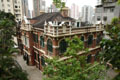
Nestled incongruously in a forest of modern residential skyscrapers in Mid-Levels, and hemmed in by two public parks, a classic century-old Edwardian building is attracting droves of visitors and students.
They come to savour its collection of outdated medical instruments and artefacts from various periods which chronicle the evolution of medical services in Hong Kong since mid-19th century.
|
|
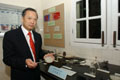
Medical marvel: The Museum of Medical Sciences showcases Hong Kong's unique history of using both Western and Chinese medicines to fight the numerous plagues that have affected us since the 1800s. Chairman of the Museum's Executive Committee Dr Tak-Fu Tse explains the museum's exhibits. |

|
Home to the Museum of Medical Sciences for the last seven years, the two-storey red-brick building has become one of the most popular destinations for students of medicine and lay people alike.
It has proven to be popular with visitors of all ages, including those who are merely curious to know what it was like when Hong Kong literally was fighting for its survival against various epidemics, particularly the dreaded bubonic plague.
The plague cut its deadly swathes through the Tai Ping Shan area, just a stone's throw south of the museum. It claimed 20,489 lives out of the 21,867 cases reported between 1894-1923, representing a fatality rate of 93.7%. The area, where most of the victims came from, has since been converted into Blake Garden to commemorate the calamity.
For the more academically inclined, many are attracted to the impressive displays of dried medicinal herbs, traditional Chinese medicine production tools, scholarly explanatory notes on the development of Chinese medicine over the last 4,000 years, not to mention a complete replica of a traditional herbal shop and a thriving herbal garden.
All these, as the Museum's Executive Committee Chairman Dr Tse Tak-fu puts it: "Creates the ideal environment to study the interface between Western and Chinese medicine."
Anxious to quash any suspicion of bias towards any particular medical stream, Dr Tse, a cardiologist, said: "We are not in the business of promoting any particular discipline or singing the praise of any professional sector. As you can see, we have also, through careful research, documented the earliest hospital services regardless of how they were received by the local populace."
Original photographs, paintings, documents and medical instruments donated by private collectors and Government departments are displayed to show, among other things, one of the first two hospitals to be built in Hong Kong - the Seaman's Hospital, the first teaching hospital - the Alice Memorial Hospital which was associated with the Hong Kong College of Medicine, the first hospital to provide Chinese herbal medicine - the Tung Wah Hospital, and other landmark events which affected the health of Hong Kong people in bygone days.
A picture of Dr Sun Yat-Sen, who is among the first batch of graduates from the Hong Kong College of Medicine, which was later absorbed into the University of Hong Kong, can be seen among the exhibits. They also include the writings and portraits of some pioneers of medical services in Hong Kong, such as the Ruttonjee family which made significant contributions to the eradication of tuberculosis through its hospital dedicated to fighting this deadly disease after the Second World War.
"The location of our museum in this building cannot be more appropriate as it was specially designed for the original tenant, the Bacteriological Institute, to undertake research in the bacteriology field in response to the periodical outbreaks of epidemics, and diseases prevalent in the early part of last century, including beri beri, typhoid, malaria and causes of infant mortality.
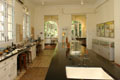
"It was later taken over by the Pathological Institute which played a vital role in local immunisation and vaccination campaigns. It was also the only vaccine production centre in Hong Kong until the late 1970s when the Institute was closed, along with the first purpose-built laboratory in Hong Kong," Dr Tse said, adding that the museum has maintained the laboratory in its original condition for public viewing.
Apart from extensive exhibits documenting the development of Chinese medicine and hospital services, special sections of the museum are devoted to the display of items relating to a particular medical practice, such as dentistry and radiology.
For visitors endowed with a particularly fertile imagination, some of the exhibits in the basement may unintentionally create certain unease as what appears to be a shackling device with restraining iron rings embedded in its heavy teak wood bed is actually a calf vaccination table while some dentistry instruments and operating tables and chairs may inadvertently resemble a torture chamber in some medieval dungeon.
"Today, as we take stock of our situation seven years to the day we swung our doors open to take in the first visitor, our individual counter has since exceeded 120,000, which included over 400 school groups and more than 1,000 community centres and organisations. On top of that, we have held over 60 public lectures concerning health and medicine and presented 12 exhibitions.
"But it is not just the numbers which assures us that our efforts in setting up this museum have not been in vain. We are even more gratified by the positive feedback we receive from visiting medical students and other members of the public, who marvel at the rich heritage of our Chinese medicine and the rapid advances we managed to achieve in community health care and hospital services. Equally noteworthy is the general appreciation of the overall educational value of our exhibits.
"By any yardstick, this is clearly a successful collaborative effort between the Government and non-governmental organisations. By giving us free use of this historically appropriate and conveniently located building, the Government also ensures that this protected architecture receives timely maintenance and continues to serve the community through us in a most meaningful manner. We really hope to see more match-ups of this nature where the Government provides the infrastructure and the non-governmental organisation comes up with the expertise.
"Our confidence in the future of this museum is reflected in the decision to launch a new Herbal Garden, in which more than 300 selected species of herbal plants will be cultivated. Although it will not yet be officially open until May, most plants are already mature enough for public viewing. And the initial feedback has been most encouraging."
Dr Tse also appealed to owners of medical equipment and other paraphernalia and documents relating to medicine that are of historical value to either donate or lend them to the museum for public display.
The museum, located at 2 Caine Lane, Mid-Levels, can be reached at 2549 5123, info@hkmms.org.hk or www.hkmms.org.hk.
Go To Top
|