|
The wetland world has a lot of fascinating scenery. Among the 10 wetland sites in Hong Kong, Lai Chi Wo and Luk Keng offer meandering shores, a dense mangrove forest, a rare seagrass bed and expansive reed beds.
A remote area sheltered by precipitous hills and challenging landscape, Lai Chi Wo's shoreline on the northeastern end of the New Territories boasts beautiful virgin shores and a quaint old forest. Many people take a three-hour hike from Wu Kau Tang in Tai Po to appreciate its wonder.
|
|
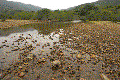
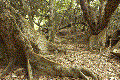
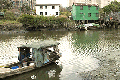
| Virgin wetland: Lai Chi Wo boasts virgin shores and a primitive mangrove forest. Nan Sang Wai has a nostalgic waterside village. |

|
The primitive forest comprises many magnificent Looking-glass Trees - a rare mangrove species in Hong Kong, whose dense leaves and branches often block the sun.
The Looking-Glass Tree has a spreading network of interweaving roots that ensure it has a firm footing in the soft, wet soil.
Interlacing climbing stems of White-flowered Derris wind their way through the forest. Their stems, some of which are thicker than a person's neck, have taken years to develop into the size they are today.
According to Hong Kong Herbarium's record, one Derris stem specimen collected here in 1904 was 40 centimetres in diameter. Who knows how long this forest has existed in Lai Chi Wo?
Mangroves are characteristic wetland plants. There are 61 true mangrove species in the world, including eight in Hong Kong. All of them can be found in Lai Chi Wo.
How the mangrove got its name
Mangrove means "red tree" in Chinese, but not all mangroves are red. The Chinese name for mangrove came from the Many-petalled Mangrove. As most parts of this tree, including its bark, are red in colour, villagers and fishermen called this plant "red tree".
Now the name mangrove is used to classify those plants that grow in tidal or coastal areas.
During high tides, the whole or part of the mangroves will be submerged.
Because of its hostile environment - soft soil, and fluctuations in the tides and the amount of salt in the water - mangroves are highly adaptable plants.
Aegiceras corniculatum, for example, grows prop roots that extend the base of plant to enable it to stand upright in the soft substratum against the tidal flow.
Black Mangrove's breathing roots enable it to breathe in the waterlogged soil that has a low oxygen content.
Seagrass beds provide food, shelter
Dwarf Eel Grass, a flowering plant which can be completely submerged in seawater, flourishes on the mudflat just off the mangroves.
This seagrass bed is the largest in Hong Kong and plays a key role in coastal ecosystem, providing food and shelter for many young coastal creatures, such as clithons, fish fry and shrimp larvae.
Seagrass occurs mostly in shallow, sheltered soft-bottom marine coastlines and estuaries and is rare in Hong Kong. In view of its ecological importance, this seagrass bed at Lai Chi Wo was designated as a Site of Special Scientific Interest in 1979.
Lai Chi Wo's shoreline and mangrove forest are part of the Yan Chau Tong Marine Park that Agriculture, Fisheries & Conservation Department manages.
Picturesque Nan Sang Wai in Yuen Long gives visitors a nostalgic country feel.
Perfect place for a calming stroll
Strolling along this path lined with Lemon-Scented Gum trees is very relaxing. You can appreciate the smooth, fair surface of a trunk, or pick a fallen Gum leaf to give your sense of smell a treat.
The path will lead you to one of the largest reed beds in Hong Kong. Watching them dance in the breeze is a delight.
This reed bed is not only a feast to the eye. Becuase of its density, it is a protected nesting place for small birds like warblers. The plant also helps filters out pollutants in passing water.
Reeds also form a natural food chain. Their debris is ideal food for crustaceans which are then eaten by fish. Birds also like to eat the reeds' seeds.
There is a small waterside village in Nan Sang Wai. The stilted chalets and old-fashioned pier are in striking contrast to urban Yuen Long across the river.
Apart from Lai Chi Wo and Nan Sang Wai, there are eight more important wetlands in Hong Kong: Yim Tin Tsai, To Kwa Peng, Kei Ling Ha in northeast New Territories; Tsim Bei Tsui and Luk Keng in northwest New Territories; Tai O and San Tau on Lantau; and Tai Tam Tuk in south New Territories. Each of them is unique and awaiting your exploration.
Go To Top
|