 |
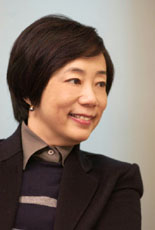
| Green vision: Dr Sarah Liao has long been committed to improving Hong Kong's environment. |


|
The Secretary for the Environment, Transport & Works is a relative newcomer to the Government, having taken up the post just over six months ago. But Dr Sarah Liao is a veteran when it comes to green issues, bringing years of knowledge and experience - and fresh solutions for fixing Hong Kong's environmental woes.
Take her environmentally friendly car: a Toyota Prius.
The hybrid has an engine that runs on gasoline and an electric motor. When the car is in motion, the turning wheels automatically charge the batteries. Most important, when the car starts and stops, the engine shuts off and the motor sets in. The result: greater fuel efficiency, fewer carbon monoxide emissions - and a reduction in air pollution.
"If every car operates on a motor, you will have no pollution problem," Dr Liao said in an interview in her office.
She bought this car for herself, but is now test-driving a Toyota luxury sedan hybrid model and is asking other department heads to take it for a spin, too. If the feedback is positive, when the time comes to replace the Government fleet it may choose this green model. Financial Secretary Antony Leung has tried it, Dr Liao said, and given it his thumbs-up.
"The environment should be a priority in everybody's bureau, not just in my bureau," she stresses. "In my bureau, of course, the works branch where all the design, engineering, planning happens, should have environment right on top of everything and not as an add-on."
Towards a green, clean Hong Kong
Her mandate is to preach the green message to all other bureaux and departments: The impact on the environment should be taken into account "right at the beginning of any project design or policy decision."
The Secretary honed her plans for a greener Hong Kong in the private sector.
Armed with a PhD in Environmental/Occupational Health from the University of Hong Kong, Dr Liao founded EHS Consultants Limited in 1988. It became known as one of Hong Kong's leading sustainable development project companies, and came to the attention of CH2M, a global consulting firm that helps clients apply technology and safeguard the environment. It bought EHS Consultants in 1997 and renamed the company CH2M Hill (China) Ltd.
Dr Liao remained as managing director, until Chief Executive Tung Chee Hwa invited her to join his team under the accountability system.
She is also a Founding Fellow of the Hong Kong Institute of Environmental Impact Assessment, and a Fellow of the Royal Society of Chemistry and of the Hong Kong Institute of Engineers.
Chemistry has always interested her, Dr Liao says, "because it's so practical. It really happens in everyday life."
Emissions trading
Improving Hong Kong's air quality is high on the Secretary's priority list. Among her favourite topics is the complex process of emissions trading.
"Let me explain," she said. "Say we have two power plants, one from Hong Kong and one from China and both need to reduce emissions by 100 units. If you do it separately, each would take care of its own costs. But for Hong Kong , to cut 100 units will probably cost 10 times as much as across the border because of all the reasons, including the cost of labour. And because it has already done so much with its power plant, the rate of marginal return would be very small."
For China, which has not done much in terms of making its power plants cleaner - yet - the cost of reducing emissions by an extra 100 units would be much less. It could then "trade" its emission reduction with Hong Kong, for a price. Because the two places share the same airshed, Hong Kong would breathe easier, too.
"It's done very meticulously, very scientifically," Dr Liao enthused. "We have done a three-year study with Guangdong, we know exactly where the emissions are, the inventory has been worked out, we also did the modelling, we actually know where the sources are that are impacting Hong Kong."
Waste reduction
She is keen to reduce the mountains of waste Hong Kong produces, too. Consider: Each day, Hong Kongers dispose of 21 million plastic bags, 700 tonnes every day. In 2001, an average of 9,300 tonnes of municipal solid waste were disposed of at landfills every day.
The use of coloured bins to separate bottles, paper and aluminium cans is a start. "But that's not enough. That only takes care of the most valuable of all the waste," she said.
The biggest problem is collecting it in such small quantities from all over. "We need to think of more efficient ways of dealing with larger quantities," she said.
That is why, beginning in March, Dr Liao's bureau will introduce a pilot scheme for four housing estates which will see wet and dry waste separated. The wet waste will still go to landfill, but all the dry waste will be collected and sold in bulk for recycling.
"Once you separate the waste, it becomes valuable," she said. "If it is economically viable, if it is a business model that will work without subsidies, then we will try it in other places. That will certainly reduce the amount of garbage and increase the recyclable contents."
Renewable energy
To cut down on fossil fuel use, Dr Liao's office is also examining renewable energy alternatives, including solar energy. Panels with photovoltaic cells have been placed atop Government towers in Wan Chai in a pilot test.
"We're gauging the efficiency and seeing how we can use it more wisely," she said.
Wind energy is another important source of renewable energy. Dr Liao is looking at the ways Northern European countries are using it. For some, it represents 30% of their energy needs. That is why she found a recent report on renewable energy use in Hong Kong disappointing. "They are talking about 1% and I think we can do more."
Two problems with wind energy she notes is whether there is enough of it and where to set it up so the noise will not bother people. "But I'm very hopeful and this is something worldwide everybody's looking for in the quest to reduce the reliance on fossil fuel. And I think Hong Kong must go along this way, too."
Adjusting to Government life
Working as a Government official is a delicate balancing act, especially when dealing with environmental issues. Green groups want to usher in changes quickly; business groups, more slowly.
"It's certainly something very different than what I'm used to in the private sector," Dr Liao said. "For the first few months I was completely thinking like a citizen of Hong Kong, but then gradually learning that being part of the Government - having to deal with issues, having to balance the various interests from different groups - is tough to say the least."
She considers herself practical-minded.
"If I can't do something, I can't pretend I'm doing something," she says. "What I can do, I'll spell out very clearly. I think it would save a lot of time on everybody's part, and use that time constructively and do something positive rather than going round and round in circles trying to dodge the problem or trying to be politically correct."
Go To Top
|