 |
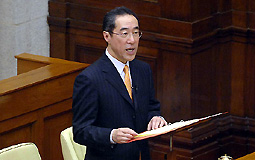
| Share the wealth: Financial Secretary Henry Tang presents his fourth Budget address to lawmakers. |


|
Financial Secretary Henry Tang has unveiled a package of budget measures designed to "share the fruits of economic prosperity with the community" and support Hong Kong's ongoing economic development and job creation.
Mr Tang said the Government's fiscal position had markedly improved as a result of the strong economic recovery. He forecast a consolidated surplus of $55.1 billion for 2006-07, much higher than the original forecast.
"Due to our economy's better-than-expected performance over the past 12 months," he said, "investment income and revenue from land premiums, stamp duty, profits tax and salaries tax alone are about $31 billion higher than the original estimates."
The Budget's centrepiece is a $20 billion package of tax concessions and other one-off relief measures including $4.9 billion cuts in salaries tax, $250 million reduction in stamp duty on property transactions, $8.1 billion in salaries-tax rebates, $5.2 billion in rates waivers and $1.5 billion in extra social-security payments.
Disadvantaged to get more aid
The Financial Secretary will also allocate about $900 million to provide more assistance to the disadvantaged, including:
* $300 million for a pilot transport support scheme to help unemployed and low-income people in remote areas seek jobs and work across districts;
* $300 million for a child-development fund to help children from disadvantaged backgrounds;
* $113 million - $103 million of which will be on a recurrent basis - for community and family-support measures in areas such as care for children and people with disabilities, care for victims of domestic violence, and mental-health services;
* $54 million on a recurrent basis and another $96 million over four years to strengthen elderly care and support services; and
* $30 million on a recurrent basis to relax the disregarded earnings arrangements under the Comprehensive Social Security Assistance Scheme.
Other key initiatives to promote the economy and employment include:
* $3.1 billion to upgrade air-traffic-control facilities and build a new Civil Aviation Department headquarters at the airport;
* Reducing by half the duty rates on wine, beer and other drinks containing not more than 30% alcohol, costing $350 million a year in lost revenue;
* $300 million to help finance film production and overcome the film-talent shortage;
* $210 million to install WiFi networks enabling free Internet access by the public in government facilities such as libraries, parks and community halls.
Gov't to spend $248b
Total government spending for 2007-08 will be $248.4 billion - up $2.8 billion, or 1.1%, from the 2006-07 estimates. Education, social welfare, health and security will account for over 60% of the total spending.
Mr Tang revealed that to complement the creation of new posts to implement some policy initiatives and to pre-empt possible succession problems in the civil service, the Government would resume open recruitment of civil servants from the next financial year.
He pledged to maintain strict fiscal discipline and manage public finances prudently. The government would continue to earmark $29 billion a year, on average, for infrastructure projects over the next few years.
He said major projects coming on-line in the next financial year - such as the Tamar development, improvement works for the 2009 East Asian Games sports facilities, and water-mains replacement and drainage works - would create about 23,000 construction-industry jobs.
$7.2b surplus forecast
An operating surplus of $7.2 billion and a consolidated surplus of $25.4 billion are forecast for 2007-08.
Mr Tang noted GDP grew 6.8% in 2006, higher than the 4% to 5% forecast by the market and the Government earlier that year. GDP growth for 2007 is forecast at 4.5% to 5.5%, with a trend growth rate of 4.5% a year from 2008 to 2011.
The Financial Secretary said Hong Kong's economy had staged a strong recovery since mid-2003, when the city was in the doldrums following the SARS outbreak.
He said employment was now at a record 3.5 million - 310,000 more than in 2003. Unemployment had fallen from a peak of 8.5% in mid-2003 to a six-year low of 4.4%.
Buoyant economy
Total retail sales were up 23% since 2003; overall investment grew 8% in 2006 - the biggest rise since 2000; stock-market capitalisation as at mid-February was 300% higher than in 2003; visitor arrivals topped 25 million in 2006 - up 60% over 2003; and negative equity cases had dropped from more than 100,000 to 8,400 by the end of 2006.
When he took over as Financial Secretary in August 2003, he needed to address the Government's serious deficit problem and restore the health of public finances, Mr Tang said. Due to the Government's and the community's efforts, the fiscal targets had been achieved in 2005-06 - three years ahead of schedule.
As a result, operating expenditure had been reduced to below $200 billion, fiscal balance had been restored in both the Operating and Consolidated Accounts, and public expenditure had been reduced to less than 20% of GDP.
Economic integration with Mainland key
Mr Tang said Hong Kong's ability to undergo continuous economic restructuring was a key element underpinning our competitiveness and our economic integration with the Mainland was pivotal to our future development.
"Hong Kong's restructuring should complement the economic development of the Mainland and create a 'win-win' situation."
To sustain future economic development and job creation, he pledged to continue to promote the financial-services sector's development, to enhance the trade and logistics industry's competitiveness, and to continue to promote the development of tourism infrastructure.
To boost the business environment, the Government will remove barriers, promote fair competition, nurture and attract talent, support scientific and technological research, and encourage innovation and creativity, Mr Tang said.
Go To Top
|