|
Permanent Secretary for Economic Development & Labour Matthew Cheung will proceed on pre-retirement leave on April 1 after 34 years and nine months of Government service. After a fruitful civil-service career, he hopes to be able to continue serving Hong Kong in other ways.
In an interview with news.gov.hk, Mr Cheung recounted his career highlights, including the challenges he has faced, while sharing tips to success in the civil service.
|
|
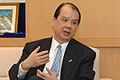
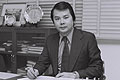
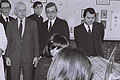
| Veteran civil servant: Matthew Cheung has held a wide spectrum of positions in the policy-making and strategic management stream. Two of his earlier postings were City District Officer (Eastern), and Assistant Private Secretary to Governor Sir Edward Youde. | |
Mr Cheung joined the Government in July 1972 after graduating from the University of Hong Kong. He began his civil-service career as an Information Officer.
Firm foundation
While in the Government Information Services, he served as Duty Officer in the newsroom and later received training in Britain. He then worked in the Hong Kong Government Office in London and later served as Overseas Liaison Editor when he returned to Hong Kong.
"My seven-year experience with GIS had laid a firm foundation for my civil-service career. The training I received turned me into a 'news hound' and helped me equip myself with an acute news sense, prompt response to international affairs and rich public relations experience.
"The exposure was very useful and it helped me a lot particularly when I later joined the Administrative Officer grade," he said.
His experience in explaining to foreign reporters and visitors Hong Kong's policy of handling Vietnamese boatpeople gave him the impetus to switch from being an Information Officer to an Administrative Officer.
The late '70s were difficult times for Hong Kong as it faced the influx of Vietnamese boatpeople. To arouse international awareness of Hong Kong's situation, Mr Cheung made arrangements for overseas journalists and prominent opinion-formers to visit Vietnamese boatpeople camps and the waters near Po Toi Island.
That was when he was inspired. "Instead of explaining government policies, I asked myself why should I not join the Administrative Service to formulate policies," he said.
Turning point
He lodged his application and was selected through open competition to become an Administrative Officer in September 1979.
During the past 27 years as an Administrative Officer, Mr Cheung held a wide spectrum of positions in the policy-making and strategic management stream. Early on he was Finance Branch's Finance Officer, City District Officer (Eastern), Assistant Private Secretary to Governor Sir Edward Youde, Industry Department's Senior Administrative Officer, District Officer (North), Administrative Assistant to Financial Secretary Sir Hamish Macleod, and Assistant Director-General of Trade.
As a senior directorate officer, he served as Deputy Judiciary Administrator; Deputy Head, Central Policy Unit; Deputy Secretary for Education & Manpower; Commissioner for Labour; and Director of Education.
Following the introduction of the accountability system in July 2002, he was appointed Permanent Secretary for Economic Development & Labour, with special responsibility for labour issues.
After joining the Administrative Service, Mr Cheung was first posted to the Finance Branch and was responsible for education funding issues. "I had to meet Deputy Financial Secretary Henry Ching every Tuesday morning to explain the Legislative Council Finance Committee funding-application documents and seek his endorsement.
"It was a precious learning opportunity that sharpened my public financial-management skills, knowledge in Government operation and ability to make correct judgements."
Historic moments
Working as Assistant Private Secretary to Governor Sir Edward Youde in 1983 was another huge challenge for Mr Cheung. The duration of his posting coincided with Sino-British negotiations on Hong Kong's future after 1997. He described the post as a 'super PhD course'. The experience widened his horizon, sharpened his political accumen and broadened his international perspective.
In 1993, he was transferred to the Judiciary to help former Chief Justice Sir TL Yang carry out administrative reform and promote the use of Chinese in courts.
Launching reforms is not easy, he said, adding that his situation was like walking on a tightrope because he had to press ahead with administrative reform without undermining judicial independence.
Despite the constraints, he enjoyed the job because he succeeded in lifting the Judiciary's 'veil of mystery' by introducing a set of performance pledges. The move enhanced the Judiciary's transparency.
Labour sector
Most of Mr Cheung's recent postings have been related to the labour, manpower and education portfolios. In 1999, he served as Commissioner for Labour and one of his primary tasks was to tackle high unemployment. With the jobless rate of people aged 15 to 19 hovering at 30%, he introduced the Youth Pre-employment Training Programme.
"Many people jest about the programme and considered it a mere propaganda exercise. Their perception was soon proven wrong," he said.
The programme trained 72,000 youths over the years and the participants' employment rate was 70%. This and the Youth Work Experience & Training Scheme subsequently introduced have been acclaimed by the International Labour Organisation as successful models for other economies. More than 120,000 young people have benefited so far from the two programmes.
During his term of office as Commissioner for Labour, Mr Cheung also succeeded in resolving a number of controversial disputes.
From 2000 to 2002, he served as Director of Education with the responsibility of implementing education reform, enhancing parent education and raising teaching standards. To gather feedback from teachers and students, he took the initiative of paying low-profile goodwill visits to one or two schools every week.
He was appointed Permanent Secretary for Economic Development & Labour in 2002, and assumed the post of Commissioner for Labour concurrently from 2003 onwards. He was also the Chairman of the Labour Advisory Board.
Soon after he assumed the labour post, the SARS crisis of early 2003 dealt a serious blow to Hong Kong's economy and labour market. The unemployment rate reached a record high of 8.5%. Mr Cheung spent every working moment formulating new employment initiatives. A number of measures - including the special incentive allowance scheme for local domestic helpers and skills enhancement project - won public acclaim.
Final tips
Concluding his civil service career, Mr Cheung said he enjoyed every moment with the Government, adding that he had no regrets at all. Denying he was a "workaholic", he said he had a strong passion for work. "I am not working for money or fame. What I am looking for is job satisfaction."
Sharing his tips for success, he said a civil servant should have a sense of commitment, should put aside personal interests and serve the community prudently with an objective, inclusive and selfless attitude.
To meet rising public aspirations for better governance, civil servants should always stay abreast of public sentiments, upgrade themselves and keep an open mind.
Mr Cheung said he has not had time to plan his post-retirement days, but wanted to take a good rest first. He would also catch up on his reading.
One thing is for certain, he will never stop upgrading himself and is prepared to serve Hong Kong in other ways.
"I stand ready to share my experience in communication, media relations, crisis management and negotiating skills with my fellow civil-service colleagues and students. The Information Services Department, Civil Service Bureau and post-secondary institutions will only need to let me know and I will be there."
Go To Top
|