 |
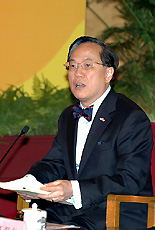
| Consensus seeking: Chief Executive Donald Tsang says after the third-term Government is formed in July, it will issue a green paper on constitutional development as the basis for public consultation, to identify a set of answers for the universal suffrage issue under the Basic Law. |

|
Fostering a community consensus on consititutional development is necessary to help Hong Kong achieve its ultimate aim of universal suffrage, Chief Executive Donald Tsang says.
Speaking at a seminar in commemoration of the 10th anniversary of the implementation of the Basic Law held in Beijing today, Mr Tsang stressed a change was needed in the confrontational political ecology that polarises the people of Hong Kong.
"This is a monumental task requiring an attitudinal change on the part of both the Administration and the political parties," he said.
"According to the design laid down in the Basic Law, the political system in Hong Kong is executive-led and headed by the Chief Executive. The Executive Authorities and the Legislature are constituted through different means. There are no concomitant and necessary correlation between the political background of the Chief Executive, the Principal Officials and members of the Legislative Council. Therefore, it cannot be taken for granted that we would gain support from LegCo on government policies, legislation and the budget.
"Unlike Governors before the reunification, the Chief Executive cannot appoint any members to LegCo. This is a fundamental change to the political and constitutional arrangements."
Since reunification, he added, the Executive Authorities have had LegCo's support, as it had passed most of the bills and appropriation bills Executive Authorities had proposed.
Emergence of political mainstream key
"However, we do face challenges. In promoting democratic development in Hong Kong, we have to bridge political differences in the community to facilitate the emergence of a political mainstream.
"To further the development of Hong Kong's political system while ensuring full implementation of 'One country, two systems' and an 'executive-led' system, we must, under the Basic Law framework, unite the political forces of the Executive Authorities and the Legislature so that they will become the political mainstream.
"As we take forward Hong Kong's constitutional development towards the ultimate aim of universal suffrage, we have to create favourable conditions for the sustained development and progressive consolidation of this political mainstream. This requires much wisdom, courage and forbearance," Mr Tsang said.
Green paper to be issued for public consultation
He said the Hong Kong Government will, in accordance with the Basic Law, steadfastly and progressively achieve the ultimate aim of universal suffrage. Since the Commission on Strategic Development was expanded in November 2005, it has been discussing options for achieving universal suffrage.
After the third-term Hong Kong Government is officially formed in July, it will issue a green paper on constitutional development and use it as the basis for public consultation, with a view to identifying a set of answers for the universal suffrage issue under the Basic Law.
Mr Tsang concluded: "With the care and support of the Motherland, a vast and rapidly developing hinterland, rich international experience and connections, as well as the rule of law, human rights and freedoms fully safeguarded, we are confident that in the days to come, we will make Hong Kong an even better place, enhance the well-being of the residents and make even greater contributions to the modernisation and development of our Motherland."
Basic Law guarantees HK's prosperity: Wu Bangguo
China's National People's Congress Standing Committee Chairman Wu Bangguo also spoke at the seminar. According to a Xinhua report, he said the last decade had proved the principle of 'One country, two systems' is workable, and the Basic Law is sound.
Mr Wu stressed Hong Kong must uphold state sovereignty, exercise a high degree of autonomy and ensure prosperity and stability. The central government will never interfere in the affairs within the HKSAR's autonomy, he said.
"To practice the capitalist system in Hong Kong with a high degree of autonomy is necessary for the maintenance of the long-term prosperity and stability of Hong Kong," Xinhua quoted him as saying.
"What I wish to stress here is that to maintain the long-term prosperity and stability of Hong Kong has always been the fundamental objective of the central government when addressing issues concerning Hong Kong," he said, adding the Basic Law was the legal guarantee of Hong Kong's long-term prosperity and stability.
Go To Top
|