|
A review of the legislation and operation of Hong Kong's Ombudsman system is underway to see if more oganisations should be brought within the Ombudsman's jurisdiction, and whether restricted areas should be relaxed.
The Ombudsman Ordinance, which has been in place for 15 years, offers a range of powers, ranging from the right to demand information, to require people give evidence under oath, and to require the provision of documents and evidence.
|
|
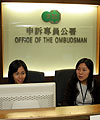
| Future plan: Ombudsman Alice Tai says there is a need to review the Ombudsman Ordinance, which has been in place for 15 years. |


|
Alice Tai, re-appointed as the Ombudsman last year, told news.gov.hk that one of the priorities for her second term is to review the ordinance and the operation of the system, and see if more can be done to improve them.
"One of the things we would be looking at is to re-examine the current restrictions that are enshrined in the ordinance. We will be looking to see whether some of the organisations currently not subject to the ordinance ought to be brought within its jurisdiction," she said.
"We would also like to examine what we call 'restricted areas', whether or not they can be relaxed so certain elements can be looked at despite the main substance of certain category of action still remaining outside the Ombudsman's purview."
Complaints rise
The number of complaints received by the Ombudsman's Office keeps rising, with 4,654 cases in 2004-05, a surge of 24.6% on 2001-02.
Ms Tai said the trend may be attributable to people's growing awareness of their rights.
"In Hong Kong, we are very fortunate in that we have lots of mechanisms to check and balance executive power. Citizens are aware of their rights and are very ready to use and exercise their rights. I believe to a large extent that contributed to the rising number of complaints."
She said departments and public organisations are always ready to make improvements when they are confronted by evidence of wrong doing.
Systematic improvement
"What is problematic, very often, is whether or not a department is able to entrench some of these recommendations so they would make systematic improvements that would prevent a recurrence of the same mistake," she said.
"In my experience, the departments most problematic in a sense that they often have fallen into the same rut are departments which have very wide interface with the public, departments whose contact with citizens is on a daily basis. All this contribute to a lot of the conflicts and complaints."
While the ordinance does not provide any statutory backing for the Ombudsman's recommendations and implementation is left to the discretion of heads of departments or orgnisations, over 95% of them have been put in place.
High implementation
Ms Tai said: "On average, we make upwards of 200 recommendations each year, whether arising from individual complaints or direct investigations. The implementation rate is over 95% each year. Even without the statutory backing, we have actually got a very high implementation rate. To that extent, I believe we have sufficient power to enforce the recommendations."
She said complaints are not the only liaison the office has with departments. Exchanges with public officers are held regularly to share experiences and techniques on how to handle difficult complainants. Direct dialogue with complaint management workshop participants will be held to better understand problems they face.
"Perhaps they find they cannot understand why we do things a certain way, or they disagree with some of the stances we take. It provides us an opportunity to have direct dialogue to explain why we do things the way we do them and how we could do things better. So I think all this helps to enhance professionalism on our part and on the part of public officers."
Regular exchanges
Apart from workshops, the Ombudsman also commends departments which are receptive to improving their governance, and identify public officers who in their day-to-day work have shown their commitment beyond the core of duty through the annual Ombudsman Award.
"Through this effort, we like to provide not just a fault-finding image, but in fact we are here, are working with government departments and public organisations, to better serve the public."
As a subvented organisation, the Ombudsman's Office is subjected to the same budget cuts as other Government departments and subvented organisations. Its staff has been downsized from 98 in 2002 to 88, and the estimated budget for 2005-06 also also fallen 6.4% on last year to $81.4 million.
Healthy reserve
The office has built up a healthy reserve, now over $86 million, thanks to the establishment of the Ombudsman as a corporation with full powers to conduct its own financial and administrative matters in 2001. Since then, the office has been given a one-line vote which allows the Ombudsman to use the budget as he or she sees fit.
"As a result of the one-line vote and taking advantage of the delinking exercise, I restructured the employment package for our staff. The pay package we now have is completely different from the civil service, but matches much more closely the market rate of comparable employment.
"Because of this reserve, I am able to say to my staff that we would be able to guarantee a viable career for anybody who is performing to the satisfaction of the Ombudsman. As a result, staff now are judged on performance alone. Unlike other subvented organisations or Government departments, they do not need to worry about that because of the fiscal situation, their employment could be at risk. They are all assured of that. And I believe that is a great cushion, a great comfort for my staff."
Ms Tai said since Christmas, all staff are hired through contracts, adding great importance will be attached to training to maintain an adequate level of experience.
(Story: Katherine Kwong. Photo: David Ho)
Go To Top
|