FS meets UK business leaders
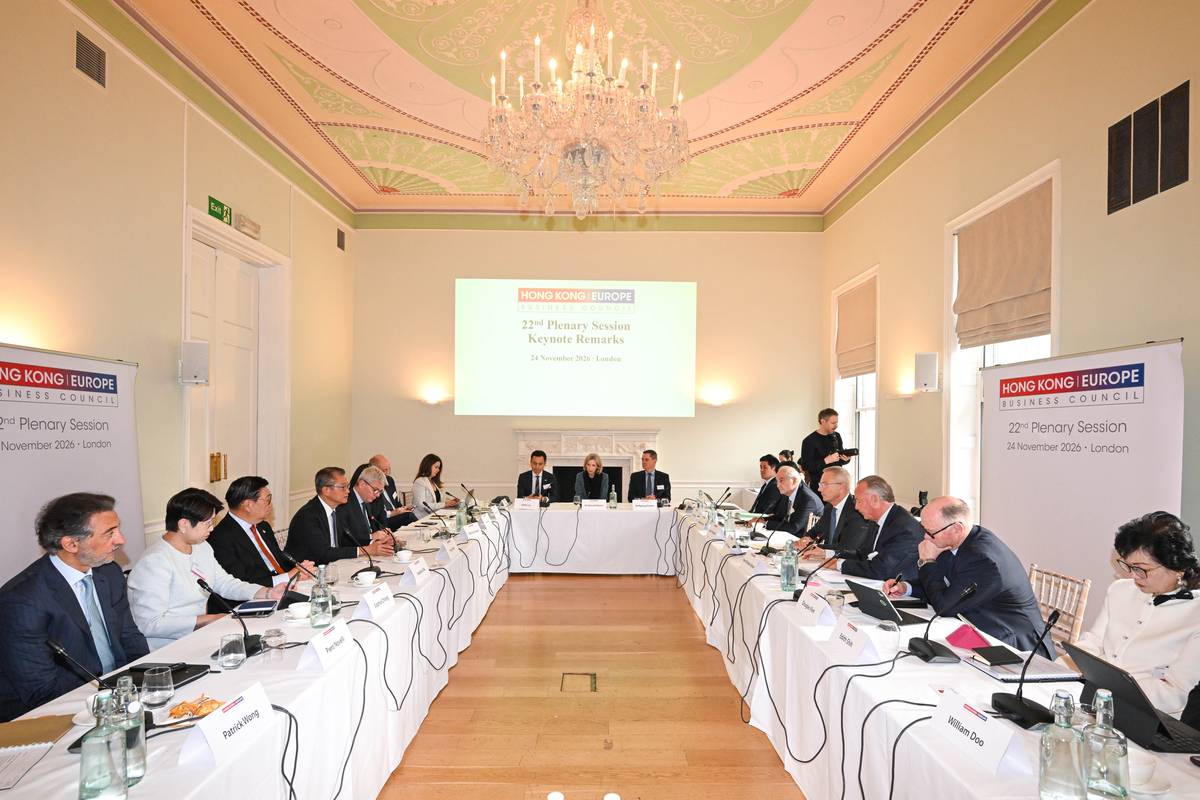
Financial Secretary Paul Chan (fourth left) attends the 22nd Plenary Session of the Hong Kong-Europe Business Council.
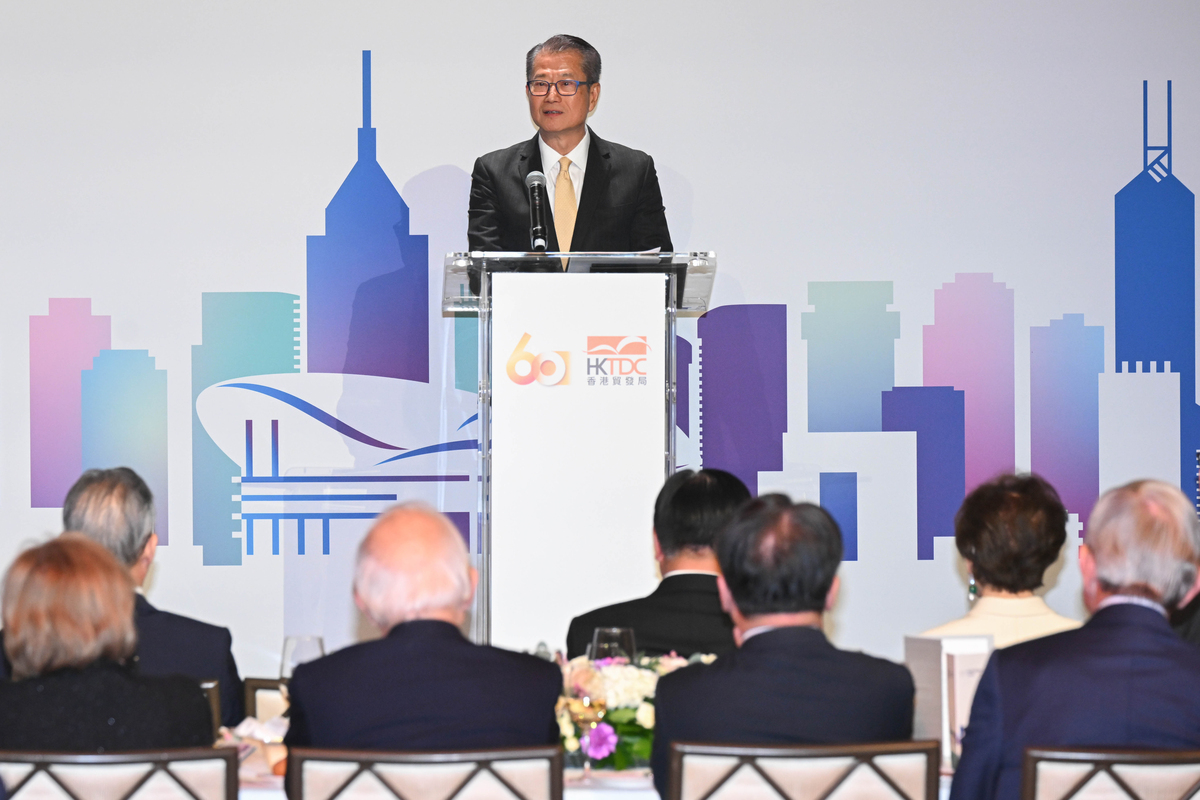
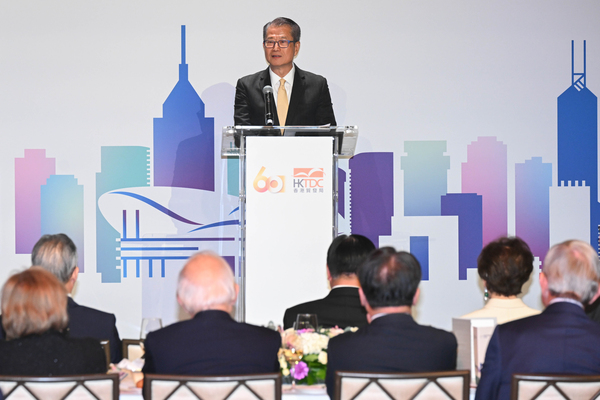
Financial Secretary Paul Chan speaks at the 40th Hong Kong Dinner in London organised by the Hong Kong Trade Development Council.
Financial Secretary Paul Chan yesterday led a Hong Kong business, trade, and innovation and technology (I&T) delegation as it continued its visit to the UK.
In London, he met members of the local business and financial sectors to brief them on the latest developments in Hong Kong and explore opportunities for co-operation between Hong Kong and the UK in finance, I&T, and professional services.
Addressing the 22nd Plenary Session of the Hong Kong-Europe Business Council, Mr Chan briefed the participants on Hong Kong’s latest economic developments. He said that the city’s merchandise exports had shown strong growth, consumption and investment had both increased, and the stock market had seen active trading while continuing to attract capital from the Mainland and overseas.
He added that Hong Kong’s First Five-Year Plan sets out its development priorities and direction for the coming half-decade, giving businesses greater certainty as they invest and expand there.
Describing the Northern Metropolis as a key base for Hong Kong’s I&T development, Mr Chan noted that infrastructure projects in the area will bring new opportunities for European investors and professional services firms.
Hong Kong will further enhance its listing regime to channel capital into industries such as artificial intelligence (AI) and biotechnology. He also encouraged European businesses to join hands with their Hong Kong counterparts to support Mainland enterprises expanding overseas by providing them with professional services.
Mr Chan then called on Chinese Ambassador to the UK Zheng Zeguang to update him on the delegation’s programme and Hong Kong’s latest economic and financial outlook. They also had an in-depth exchange on the international landscape, China-UK relations, economic conditions in the UK and Europe, and the expansion of Mainland enterprises into Britain.
At noon, Mr Chan spoke at a luncheon hosted by the Hong Kong Association and exchanged views with members and guests. He emphasised that a key goal of Hong Kong’s First Five-Year Plan is to accelerate its development as an international I&T hub, adding that the city can help UK companies bring technologies to the Mainland while connecting them with local partners. British firms can raise funds, conduct research, and test new technologies in Hong Kong, while drawing on the advanced manufacturing capabilities of the Guangdong-Hong Kong-Macao Greater Bay Area (GBA) to turn research outcomes into products.
Mr Chan outlined four areas for closer I&T co-operation between Hong Kong and the UK.
First, UK universities could establish joint laboratories with Hong Kong institutions or set up campuses in the Northern Metropolis. Second, British companies could use the city as a base for their Asian operations. Life and health technology firms, for example, could establish research and development teams in the Loop to conduct cross-boundary clinical trials and develop new drugs.
Third, UK professional services firms could help Hong Kong-based Mainland technology companies obtain product certification and enter the UK and European markets. Fourth, British funds, university endowments, and corporate investors could co-invest with the Hong Kong Investment Corporation Limited.
He invited participants to visit the Northern Metropolis and expressed hope that the Association would continue to bring businesses from both places together to foster further co-operation.
Mr Chan then addressed a roundtable on digital assets organised by TheCityUK, a UK financial industry body. He outlined the policy principles and measures guiding the regulation and growth of digital assets in Hong Kong, as well as the latest trends in stablecoins and tokenisation. He also exchanged views with representatives of the local financial sector on market evolution in both jurisdictions, and explored opportunities for their financial institutions to work together in this area.
In the evening, Mr Chan spoke at the 40th Hong Kong Dinner in London organised by the Hong Kong Trade Development Council. He said that, according to UK government figures, bilateral trade reached £33 billion in the year to June, up 23% year on year. Meanwhile, Hong Kong’s economy expanded by 5.1% over the first nine months of this year, with the Government forecasting full-year growth of 4.8%.
Mr Chan highlighted that Hong Kong promotes AI as a core industry while supporting its adoption across other sectors. He drew a distinction between using AI and building a business around it: a company that simply uses AI does things faster, whereas an AI-native firm rebuilds its products, organisation, and operating model.
Citing medical technology as an example of Hong Kong-UK co-operation, Mr Chan said that surgical robots developed by Cornerstone Robotics – a Hong Kong company founded by a professor at The Chinese University of Hong Kong – are now operating in National Health Service hospitals in Portsmouth and east London. He added that approximately a dozen InnoHK laboratories in the city are run with British institutions, such as the University of Cambridge, the University of Oxford, Imperial College London, and University College London.
He welcomed British universities, laboratories, and innovative companies to participate in the development of the Northern Metropolis. Three university towns covering over 1,000 hectares are being built there – with about 300 hectares for campuses and the rest for laboratories, technology parks, industry, and housing – to bring together the combined strengths of education, research, and industry, he said.
Mr Chan said that what the GBA brings together globally includes not only goods and services, but also technology, capital, talent, advanced manufacturing, and the know-how to take research to market. He noted that as Mainland enterprises invest in the UK and Europe, bankers, lawyers, accountants, and advisers in Hong Kong and London can work together to help them establish and expand their operations.
On financial markets, Mr Chan said that Hong Kong and London can deepen ties in offshore Renminbi (RMB) business and gold trading. He remarked that as the world’s largest offshore RMB centre and the leading centre outside Asia respectively, the two cities span the trading day and have strong grounds to link their markets more closely.
Mr Chan added that Hong Kong is building a complete gold value chain – covering trading, clearing, storage, and delivery – ahead of the formal launch of its central gold clearing system early next year, while exploring co-operation on delivery standards with the London Bullion Market Association.
He concluded that Britain has long been part of the Hong Kong story, and that new investment continues to renew the ties between the two places.
Mr Chan will lead the delegation to the Netherlands today to continue the visit.