FS begins visit to Cambridge, UK
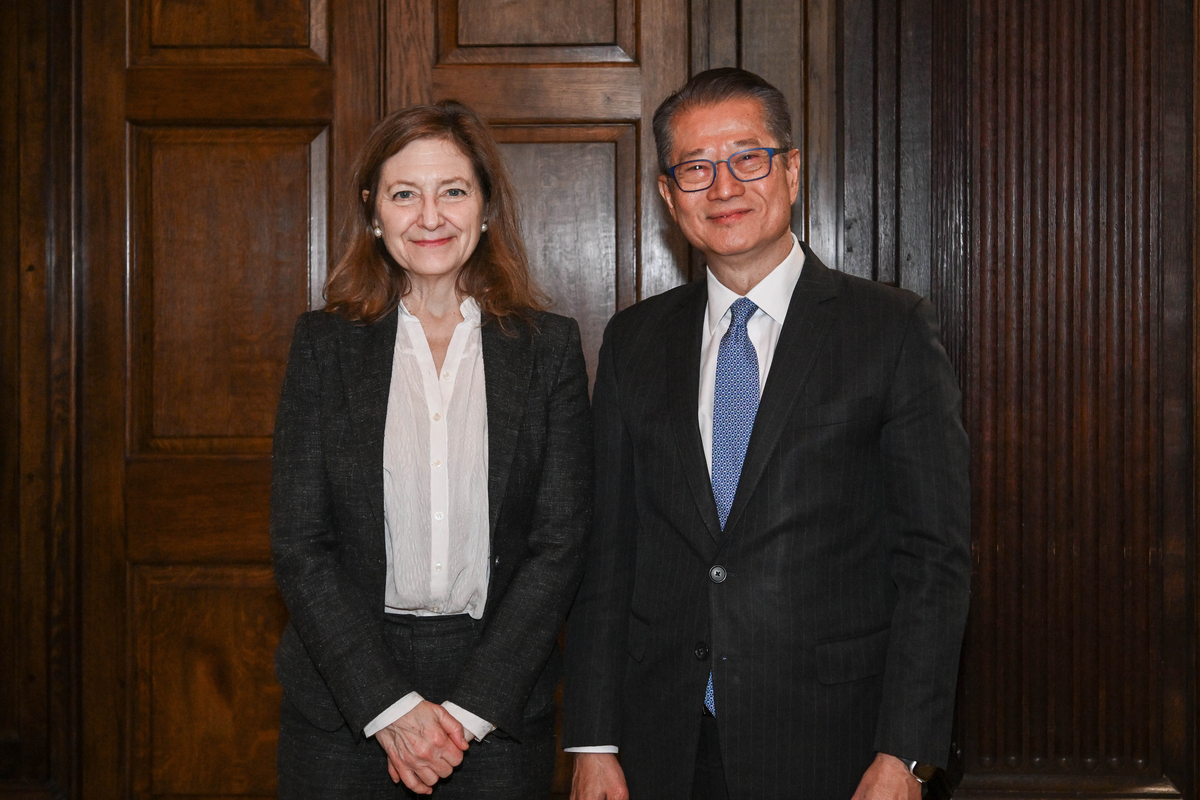
Financial Secretary Paul Chan (right) meets with Vice-Chancellor of the University of Cambridge Deborah Prentice (left).
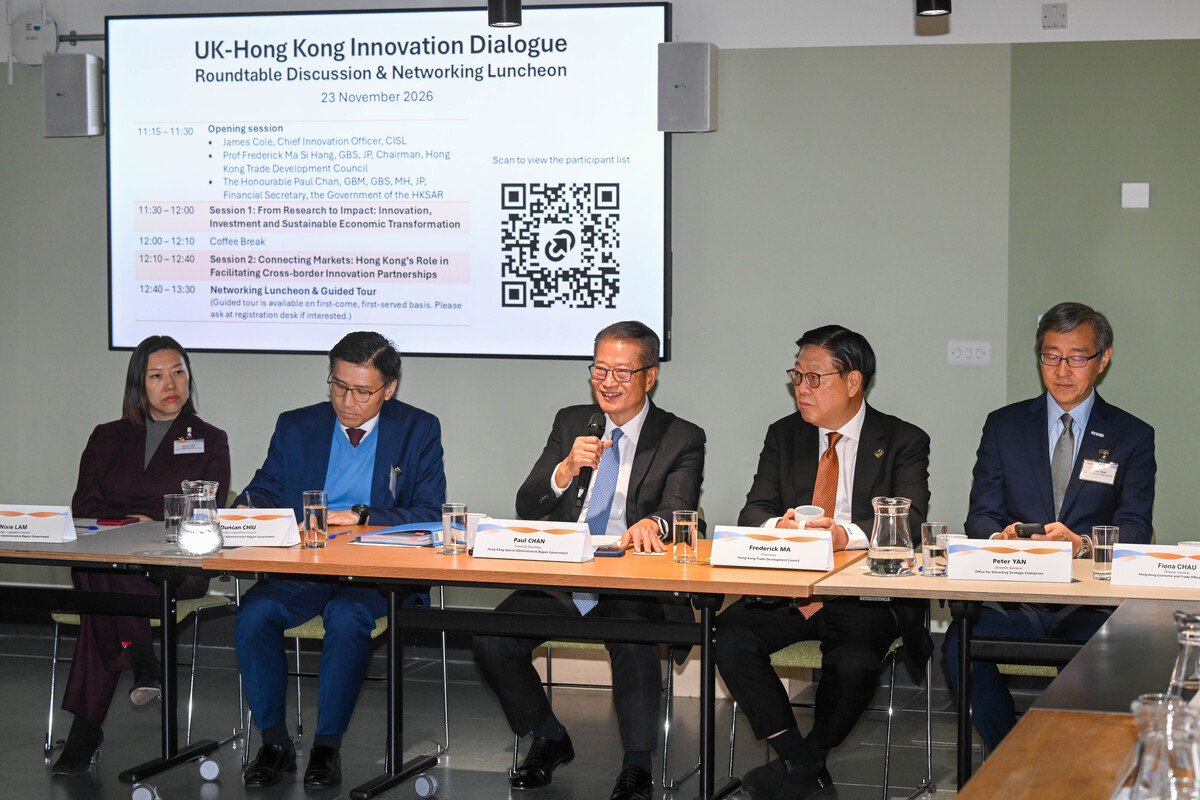
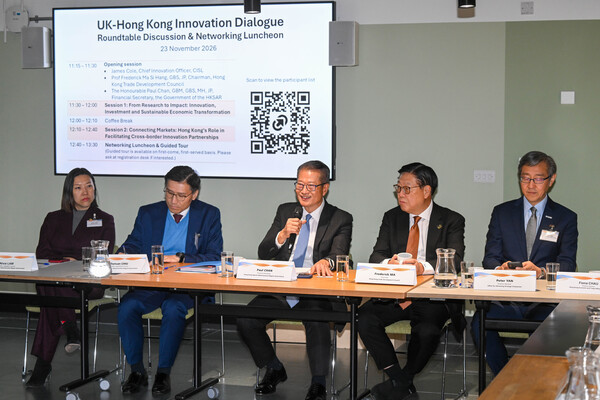
Financial Secretary Paul Chan (third left) attends the UK-Hong Kong Innovation Dialogue with the delegation.
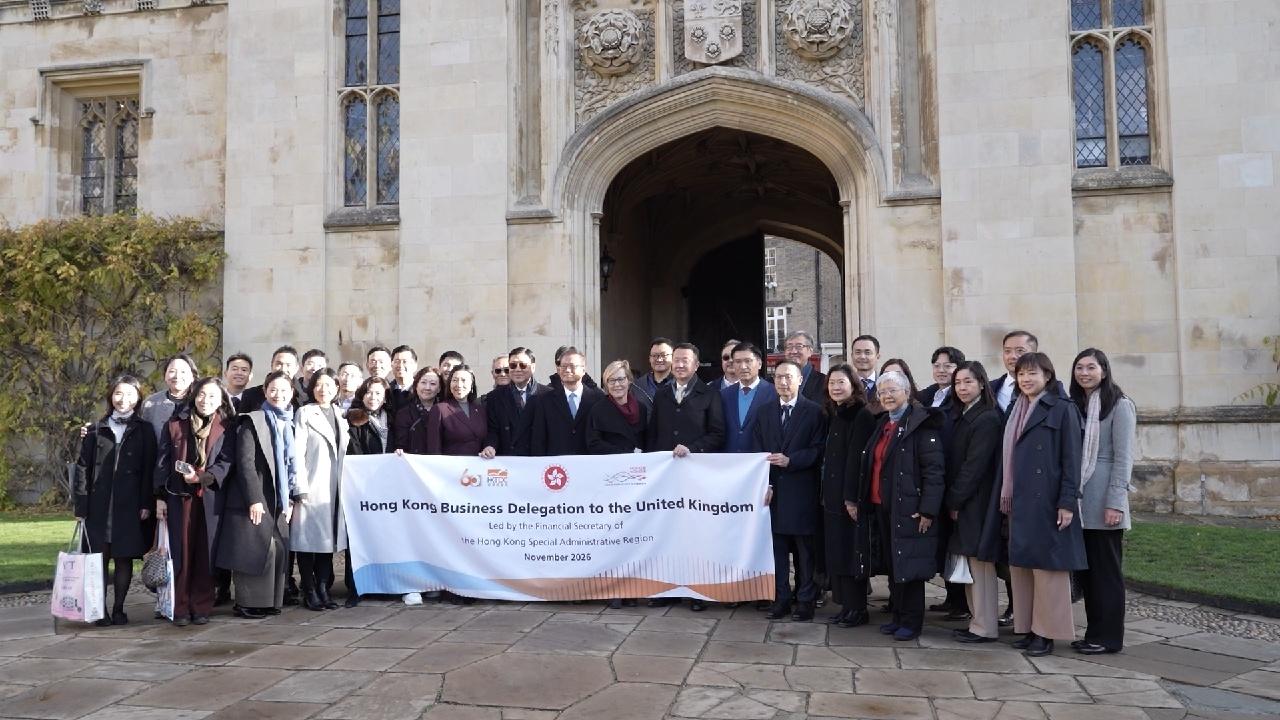
Financial Secretary Paul Chan, leading a Hong Kong business and innovation and technology (I&T) delegation, began his visit to Cambridge in the UK yesterday.
Members of the delegation include Chairman of the Hong Kong Trade Development Council (HKTDC) Frederick Ma and three Legislative Council (LegCo) members.
In the morning, Mr Chan met University of Cambridge Vice-Chancellor Deborah Prentice to discuss co-operation in scientific research, talent nurturing and the commercialisation of research outcomes. He briefed her on Hong Kong’s latest I&T progress and the Northern Metropolis University Town, inviting the university to expand research ties with local institutions.
Mr Chan then led the delegation to the UK-Hong Kong Innovation Dialogue – a roundtable co-organised by the HKTDC and the Cambridge Institute for Sustainability Leadership – for an in-depth exchange with local academics and representatives from think tanks, I&T firms and the investment sector.
Speaking at the roundtable, Mr Chan noted the strong foundation for UK-Hong Kong research collaboration, pointing out that eight UK universities, including Cambridge, have partnered with Hong Kong institutions to set up more than 10 joint laboratories under the InnoHK clusters. He added that Cambridge-headquartered biopharmaceutical firm AstraZeneca has also established a research and development (R&D) centre in Hong Kong.
Describing Hong Kong as an international financial centre and a bridge linking the Mainland with the world, Mr Chan noted that I&T is one of the four priority centres under Hong Kong’s first Five-Year Plan, which aims to boost original innovation and accelerate the city’s growth into an international I&T hub. He said Hong Kong and Cambridge can deepen ties across capital, connectivity and talent to jointly advance scientific research and commercialise outcomes.
On capital, Mr Chan said that Hong Kong provides technology firms with end-to-end financing from the laboratory to the public market, backed by private equity and venture capital funds managing about US$250 billion. He noted that the Hong Kong Investment Corporation Limited has invested in more than 250 projects – attracting over eight dollars in market co-investment for every dollar spent – while over 90 pre-revenue biotech firms have raised more than 14 billion British pounds in Hong Kong since listing rules were relaxed in 2018.
On connectivity, he highlighted that the Guangdong-Hong Kong-Macao Greater Bay Area (GBA), home to 88 million people, offers top innovation clusters and advanced manufacturing as a testing ground, production base and market for new technologies. He added that the Hong Kong Park of the Hetao Shenzhen-Hong Kong Science & Technology Innovation Co-operation Zone has started operating, with over 100 enterprises and institutions already moved in.
The financial chief noted that UK-approved drugs can apply for Hong Kong registration using that approval alongside local clinical trial data, and subsequently be used in designated GBA Mainland healthcare institutions under the Hong Kong & Macao Medicine & Equipment Connect policy, which had approved 79 drugs and 100 medical devices by the end of September. With many Mainland technology firms using Hong Kong as an international base, the city’s common law system and robust intellectual property protection also make it an ideal nexus for UK-China I&T collaboration, he added.
On talent, Mr Chan said Hong Kong boasts five universities in the world’s top 100 and continues to draw leading scientists, including two Nobel laureates in physics who joined the University of Hong Kong over the past year.
He invited UK research institutions and businesses to partner with delegation members, consider establishing offices and R&D bases in Hong Kong and tap the city’s capital market for fundraising. Given Cambridge’s research strengths and Hong Kong’s edge in commercialisation, financing and accessing Asian markets, he expressed hope that both sides would combine their advantages to bring research innovations to wider markets.
Following lunch at St John’s College with leaders and academics from various University of Cambridge colleges, Mr Chan and the delegation met Cambridge Enterprise, the university’s commercialisation arm. They discussed its experience in intellectual property commercialisation, start-up incubation and early-stage investment, while exploring collaboration opportunities with Hong Kong.
The delegation later visited AstraZeneca’s Discovery Centre in Cambridge, where management briefed them on advances in new drug R&D and artificial intelligence applications. Both sides discussed deepening co-operation to jointly develop innovative drugs and expand market reach using Hong Kong’s strengths as an international health and medical innovation hub, with Mr Chan welcoming AstraZeneca to further expand its local R&D operations.