Youth explore aerospace science
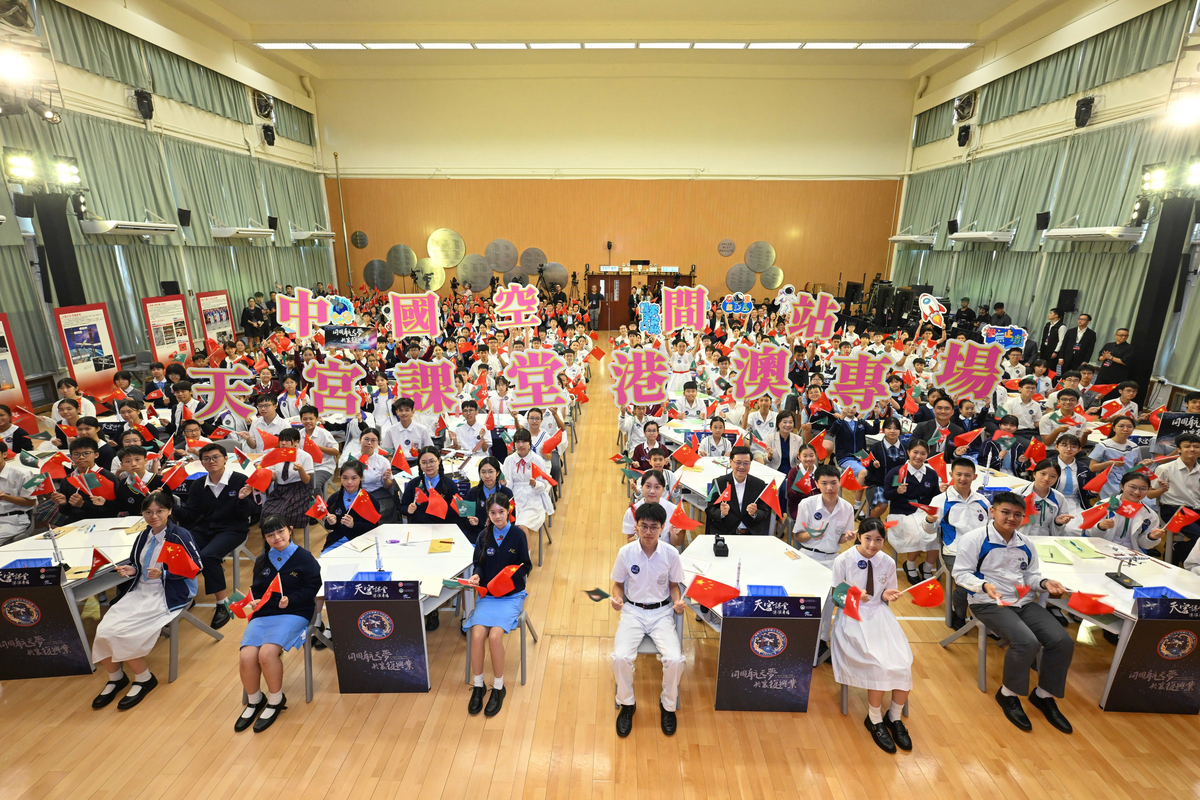
Chief Executive John Lee (second row, fifth right) attends the "Tiangong Class" Hong Kong and Macao Designated Session.
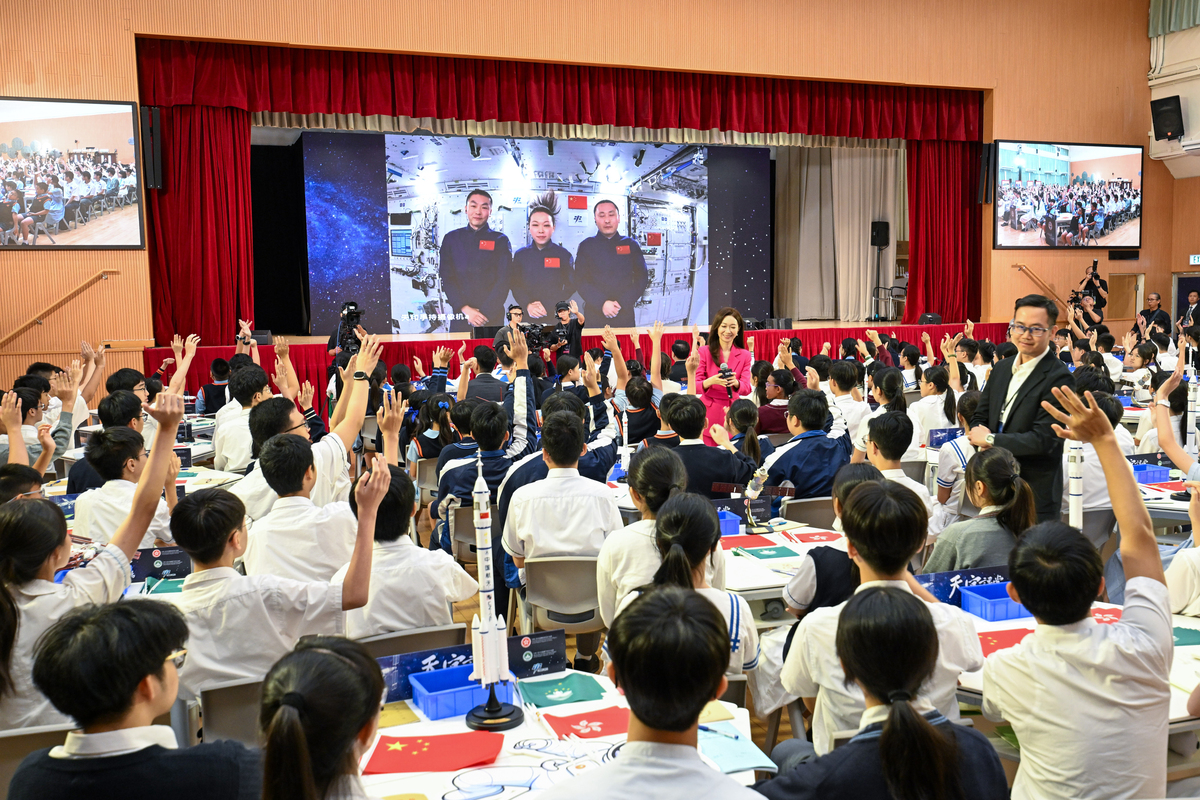
Lai Ka-ying (centre on screen), Zhu Yangzhu (right on screen), and Zhang Zhiyuan (left on screen) interact and answer questions from students from Hong Kong and Macao.
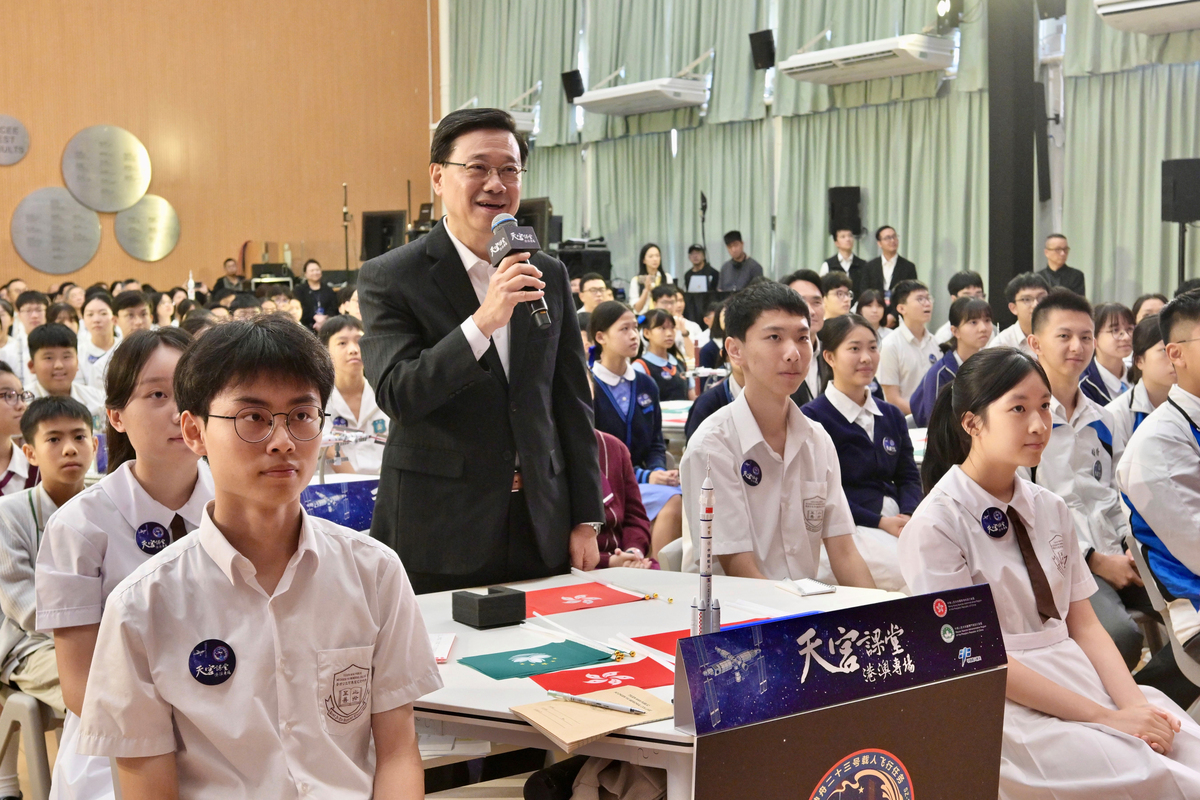
Mr Lee (centre) engages in a rare space-to-Earth dialogue with the crew members of Shenzhou-23.
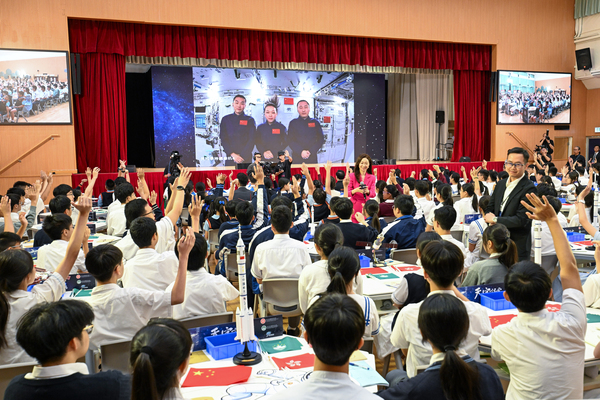
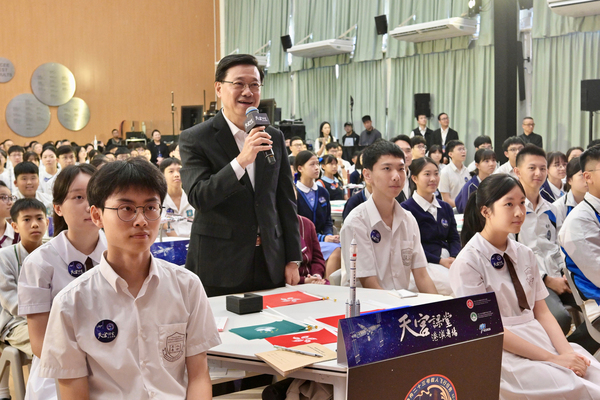
Hong Kong and Macau youth joined a "Tiangong Class" today to engage with space experts and the Shenzhou-23 crew currently carrying out a manned space mission on the Chinese Space Station.
Mission commander Zhu Yangzhu, astronaut Zhang Zhiyuan and Hong Kong's first payload expert Lai Ka-ying served as "space teachers" to deliver expert lectures to students, conduct real-time science experiments, and engage in an interactive "dialogue between space and Earth".
Organised by the Hong Kong Special Administrative Region Government, the Macao SAR Government, and the China Manned Space Agency, the "Tiangong Class" Hong Kong and Macao Designated Session was held at Ms Lai's alma mater, Tsuen Wan Public Ho Chuen Yiu Memorial College.
Over 200 participants attended the session, which featured in-orbit demonstrations, expert lectures and a question-and-answer session. The participants included primary and secondary school teachers and pupils from Hong Kong and Macao, alongside tertiary students, researchers, technology professionals, and youth organisation representatives.
The session lasted approximately 1.5 hours, during which Ms Lai introduced the operational process of the Multi-Spectral Imaging Carbon Observatory (MUSICO). Developed by the Hong Kong University of Science & Technology, MUSICO undertakes the important task of monitoring global greenhouse gases, contributing to national aerospace programmes and global sustainable development.
The astronauts also introduced the Tiangong Space Station’s facilities, including the core module instruments and experimental facilities, the space vegetable garden, the space kitchen and space food, and shared their daily lives and scientific research work on the space station.
Speaking at the event, Chief Executive John Lee thanked the China Manned Space Agency for its support, as well as the various organisations and departments for their joint efforts, which have enabled students from Hong Kong and Macao to learn from the astronauts aboard the Tiangong Space Station.
Mr Lee noted that, over the more than 30 years of the development of China's manned space programme, every step has embodied the Chinese nation's indomitable spirit of self-improvement and courage in exploration.
He added that when the delegation from China's manned space programme visited Hong Kong in 2023, it sowed three important seeds for the city: a seed to foster national pride, a seed to explore science and technology, and a seed to encourage the pursuit of dreams. As Hong Kong's aerospace research and development has progressed from ground-based support to in-orbit operations in space, enabling Hong Kong people to explore the cosmos, it demonstrates that these seeds have not only taken root and sprouted, but are also thriving.
Mr Lee also encouraged all sectors of society, particularly young people, to actively participate in the science popularisation and awareness-raising activities currently organised by the Hong Kong SAR Government under the theme "A Shared Cosmic Vision for National Rejuvenation".
He expressed the hope that the younger generation would look to astronauts as role models, serving the nation in building a strong aerospace country, thereby writing a brilliant chapter for the Chinese nation.