Govt's efficacy enhancement set
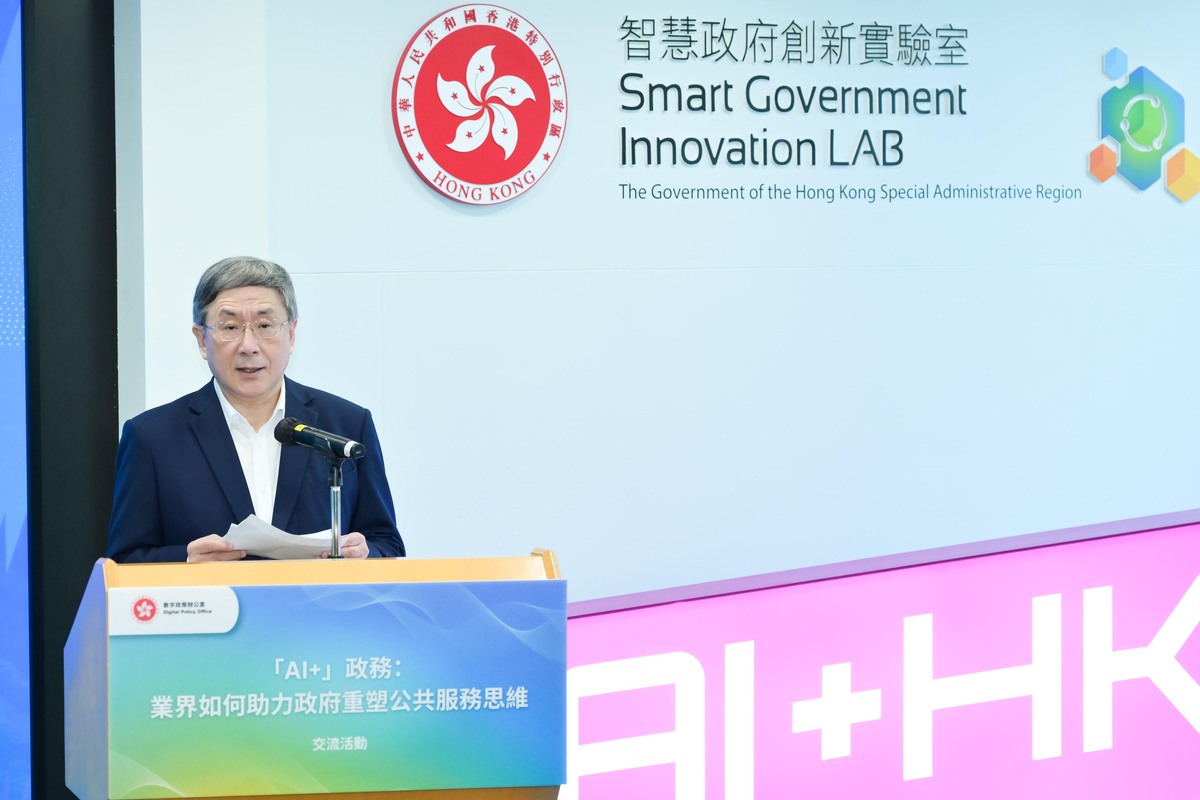
Deputy Chief Secretary Cheuk Wing-hing speaks at the exchange session on “’AI+’ Civil Service: Industry’s Role in Reshaping the Government’s Approach to Public Service Delivery”.
The Government today announced that the AI Efficacy Enhancement Team has facilitated and implemented its first batch of 30 Efficacy Enhancement Projects. The initiatives are being rolled out in phases starting from mid-2026.
Led by Deputy Chief Secretary Cheuk Wing-hing, the team was established following the 2025 Policy Address to co-ordinate and steer departments in applying artificial intelligence (AI) technology, exploring process re-engineering and driving technological reforms.
The initial phase involves 13 government departments and includes 10 high-impact flagship projects. These cover public and business sectors closely connected to daily life, including transport licences, food business licences, leisure and sports facilities, environmental hygiene, complaint handling and environmental protection.
The 30 projects mainly optimise public service queuing and application processing workflows to deliver a faster, more user-friendly experience. In certain cases, the integration of AI has drastically cut waiting or processing times by up to 90%.
Internal government procedures are also being streamlined. Through process re-engineering and AI technology, some workflows have been compressed from several days to just a few hours. Additionally, the time required for case analysis or triage has been shortened by half or more.
Mr Cheuk noted that a dedicated AI task force, comprising experts from the Digital Policy Office and the Census & Statistics Department, is collaborating with leading AI enterprises to support these departments partnerships. “This arrangement ensures AI applications match with the actual operational needs of departments and new developments and trends of AI,” he explained.
“With the objectives of achieving pragmatic implementation and a swift rollout, we are striving to launch Efficacy Enhancement Projects progressively in 2026 and 2027,” he added. “Launching these projects within a short period of time reflects the Government's determination and execution capability in smart transformation.”
Mr Cheuk pointed out that the first batch of projects has also shown the potential of promoting AI across departments.
“Despite the diverse functions and responsibilities of different departments, there are similarities in daily workplace scenarios, such as online reservations, license applications, audits and assessments, responding to enquiries and environmental monitoring,” he said.
“If a solution could be successfully applied in a pilot department, the relevant experience, technologies and operation models can be extended to other departments and similar work scenarios with suitable adjustments,” he added.