Japan seafood import control set
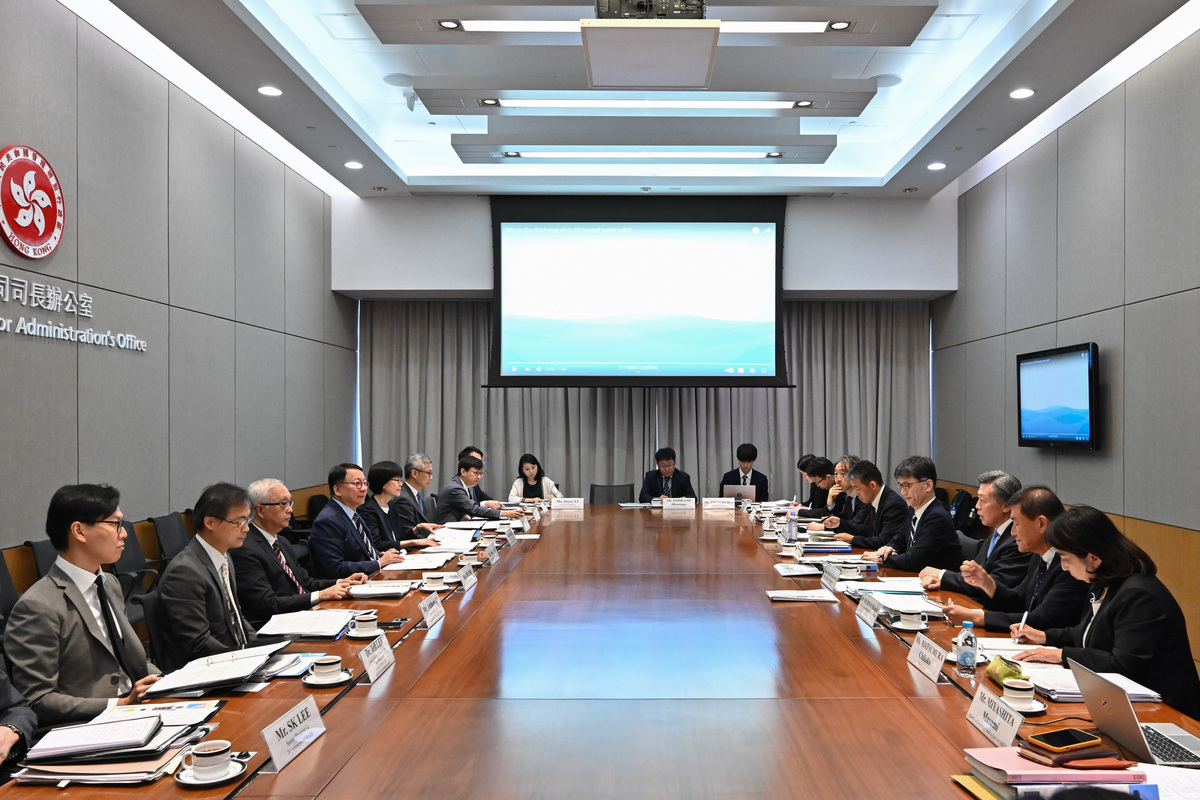
Chief Secretary Chan Kwok-ki (fourth left) and Secretary for Environment & Ecology Tse Chin-wan (third left) meet Consul-General of Japan in Hong Kong Kenichi Okada (third right).
The Government announced today that to ensure food safety and public health, it plans to prohibit the import of aquatic products originating from ten metropolis or prefectures of Japan once the country commences the discharge of wastewater from Fukushima.
Chief Secretary Chan Kwok-ki and Secretary for Environment & Ecology Tse Chin-wan met Consul-General of Japan in Hong Kong Kenichi Okada and relevant Japanese officials today, and reiterated to the Japanese side that the Japanese authorities should not discharge the wastewater from the Fukushima nuclear power station (FNPS) into the ocean unilaterally without the consensus of the international community so as to avoid bringing about irreversible impacts on the environment.
The Government's inter-departmental taskforce reviewed the final report of the International Atomic Energy Agency (IAEA) and relevant information provided by Japan.
Having considered the final report of the IAEA, relevant information provided by Japan, opinions of the experts in Mainland and risk assessments, the Government has come to the view that there is currently no guarantee that the purification system can operate continuously and effectively in the long term after the commencement of the discharge plan, and that the plan will not pose any potential risks to food safety and marine ecology.
To ensure that all food imported from Japan is safe and fit for consumption, based on the precautionary principle, the Government currently plans to prohibit the import of all aquatic products originating from Tokyo, Fukushima, Chiba, Tochigi, Ibaraki, Gunma, Miyagi, Niigata, Nagano and Saitama once the Japanese side commences the discharge of wastewater.
These aquatic products include all live, frozen, chilled, dried, or otherwise preserved aquatic products, sea salt and unprocessed or processed seaweed.
Additionally, the Government will maintain the existing import control measures on certain food products against the five prefectures, ie Fukushima, Chiba, Tochigi, Ibaraki and Gunma since the 2011 Fukushima nuclear incident.
As regards media reports claiming the stringent measures imposed by the Government were intended to impress Beijing, the Government said it must emphasise that, under “one country, two systems”, Hong Kong exercises a high degree of autonomy while preserving its own economic and social systems. Plus, it added that Hong Kong is a free port as well as a separate customs territory.
The Government explained that it administers the food safety regulatory regime with regard to the actual situation and considerations in Hong Kong to safeguard food safety and public health.
Furthermore, the Government stressed that it will continue to maintain close communication with the Japanese authorities, closely monitor the latest situation regarding import of food from Japan and the discharge plan of the FNPS, and perform risk assessments to help safeguard food safety and the public health of citizens in Hong Kong.