Vaccination the way forward
Chief Executive Carrie Lam
With the fourth wave of the COVID-19 epidemic ending at the end of May, we have launched the Early Vaccination for All campaign in tandem with the aim to collaborate with various sectors in the community to raise the vaccination rate as soon as possible to build an immune barrier in Hong Kong. Over the past month, although sporadic local cases have been recorded on two occasions, yet with speedy, stringent and intensive contact tracing as well as testing and quarantine operations, no community transmission has been detected so far. After assessing the epidemic situation, we have further adjusted the social distancing measures at the end of June in response to the aspirations of different sectors of the community.
The latest epidemic situation
For more than a month after April 23, there had been no local cases in Hong Kong. According to the views of experts, the fourth wave which had been plaguing Hong Kong for half a year ended at the end of May. However, Hong Kong has recorded two cases with unknown sources and mutant virus strains in early and late June, in which a total of four people were infected, including a mother and two daughters in the same family with the N501Y mutant strain and an airline ground crew staff member with the L452R mutant strain. Having regard to the experience in other places and the characteristics of mutant virus strains, some experts considered that society has to accept that it is difficult to completely avoid sporadic cases. What is important is for us to adopt effective measures against individual cases in the first instance to cut the transmission chain as soon as possible.
In addition, there are more than 60 imported cases in June from places such as Indonesia and the UK. It is necessary for us to continue to adjust the measures to prevent the importation of cases having regard to the epidemic situation in various places to minimise the chance of the transmission of the virus into the community.
Anti-epidemic efforts
In line with the new direction in fighting the pandemic announced on April 12, we have taken stringent and targeted measures to tackle the sporadic local cases. When a local case with an unknown source of infection and two linked cases were detected in early June, we stayed vigilant and in a short period of time cordoned off the building where the patients lived for compulsory testing, as well as tracing and arranged 143 close contacts to undergo quarantine in the government quarantine centres. Compulsory testing notices were also issued to more than 30 premises, with a total of more than 30,000 tests conducted and no other infected people were identified. We conducted epidemiological investigations with experts at the places where the patients had visited, including a pet shop, the premises in an industrial building where a patient took tutorial class and their residence, collecting more than 100 specimens with no source of infection being detected. We also worked with the university teams to compare the genes of the case with cases in Shenzhen and Taiwan as well as those in the global virus genome database with no common source being found. Although we have yet to find out the source of infection, the virus, fortunately, did not spread in the community.
In view of another local case with an unknown source in late June, we have equally taken stringent anti-epidemic measures, including immediately cordoning off the relevant building for testing, arranging more than 100 close contacts to undergo quarantine at the quarantine centres and subjecting another 100 odd close contacts of the family members of the confirmed case to three days of quarantine, as well as conducting more than 30,000 virus tests. It is worth noting that before the confirmation of the infection of the subject person, the research team, comprising members of the University of Hong Kong, the Government’s Drainage Services Department and Environmental Protection Department, has already detected the virus in the sewage samples collected in the district where the subject person lives, demonstrating once again the importance of the application of technology. On the prevention of importation of cases, we have adjusted the risk levels of Cambodia, Thailand, Vietnam, the UK, Colombia, Korea and Indonesia, having regard to their epidemic situation. We have also enhanced the testing arrangements for people arriving in Hong Kong from the Mainland, Macau, Taiwan and Singapore. The major measures introduced are set out below chronologically:
|
Date |
Event |
|
May 25 |
The Government announced the extension of the COVID-19 Vaccination Programme to Mainland residents who are holders of the Exit-Entry Permit for Travelling to and from Hong Kong and Macau and will stay in Hong Kong for a period of time starting from May 28, and its plan to provide vaccination for non-refoulement claimants and refugees recognised by the United Nations High Commissioner for Refugees in Hong Kong starting from July. |
|
May 31 |
The Government announced the launch of the Early Vaccination for All campaign and the provision of a day of vaccination leave to Government employees for each dose of vaccine received; and appealed to the business community and organisations to encourage their employees to get vaccinated and organise vaccination promotion activities. |
|
June 3 |
The Secretary for Food & Health approved the lowering of the minimum age for receiving the BioNTech vaccine from 16 to 12. Relevant people may make reservations for vaccination through the designated website starting from June 11. |
|
June 18 |
The Government disbursed a one-off Special Allowance for Vaccinations of $800 to the staff members of the residential care homes for the elderly (RCHEs), residential care homes for persons with disabilities (RCHDs), nursing homes, etc, and implemented the restricted visiting arrangement for RCHEs and RCHDs subject to the continued implementation of measures to minimise social contact and prevent infection. |
|
June 21 |
|
Early Vaccination for All
In the past two months or so, following the new direction in fighting the pandemic announced on April 12, our anti-epidemic work has attained certain results. We are pleased to see that our society has regained some energy and the public can ease their anti-epidemic fatigue. Almost all premises have already resumed business to a different extent; large-scale events such as the Track Cycling Nations Cup, Art Basel Hong Kong, French May Art Festival as well as seminars and forums organised by various organisations took place safely one after another; the Hong Kong Diploma of Secondary Education Examination was held smoothly and all schools can let students return to school for face-to-face classes; there are also more gatherings and social activities among the public. Taking into account the epidemic situation and the aspirations of various trades and the general public to resume normal business and life, we have further relaxed social distancing measures starting from June 24, including relaxing the number of users in swimming pools, which we believe is particularly welcomed by the public in summer. With an increase in business activities and more people going out, the economic and employment situation has evidently improved in recent months.
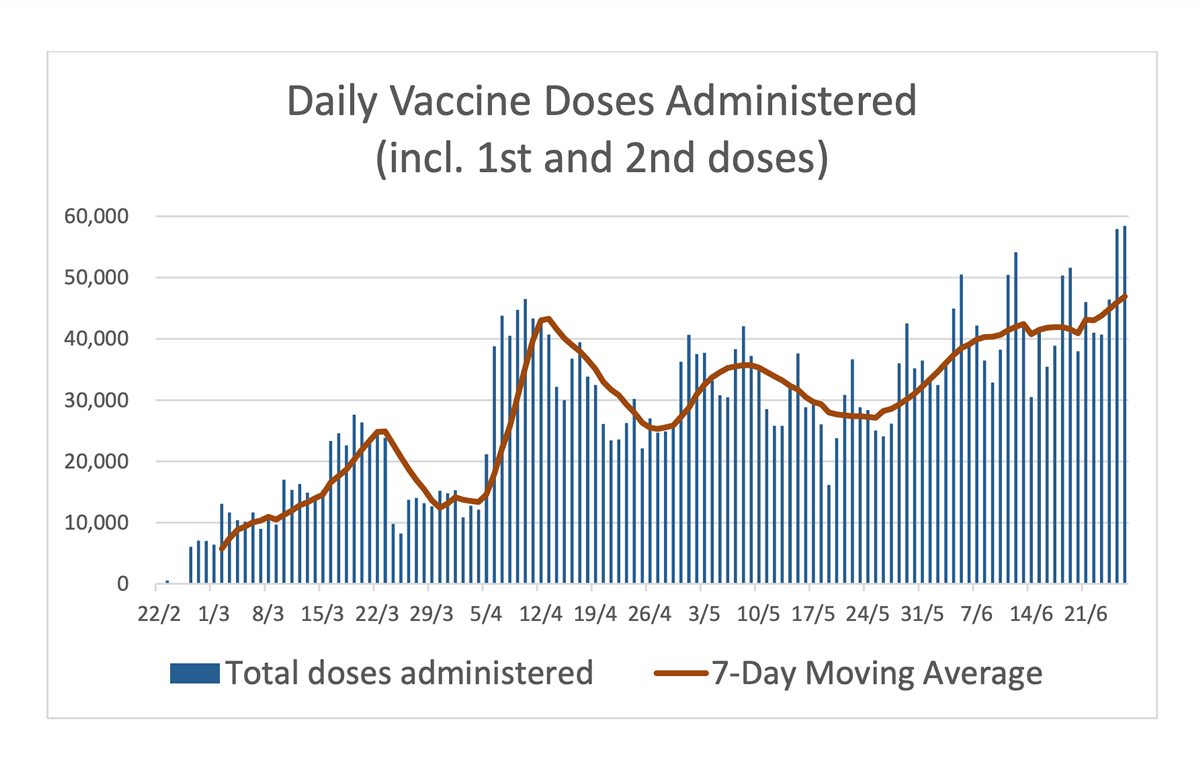
We very much hope to adhere to the new direction in fighting the pandemic, keep the current good momentum going, and further relax social distancing measures when conditions permit. However, all this can only be done on the basis of a satisfactory vaccination rate. I would like to thank the business community and various organisations for actively responding to the Early Vaccination for All campaign launched by the Government and rolling out various activities or measures to encourage vaccination. As a matter of fact, we have seen an increase in the vaccination rate in June, though it is still not good enough. As of June 26, a total of 2.12 million people have received the first dose of vaccine, accounting for about 31% of the eligible population.
In a nutshell, to effectively guard against the spread of virus variants in the community or even the fifth wave of the epidemic, we must count on vaccination; and only by achieving a satisfactory vaccination rate (which experts generally believe should reach 70% of the eligible population) will we be in a better position to consider further relaxing social distancing measures or resuming cross-border travel with other places.
Please act immediately to encourage or arrange for your employees, family and friends to get vaccinated as soon as possible!
Chief Executive Carrie Lam issued this article titled Early Vaccination for All on June 27.