|
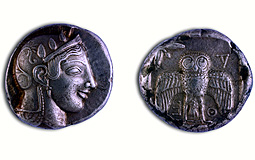
Silver decadrachm of Athens: (c. 460-445 BC) A head of Athena, the patron goddess of Athens, is on the front while her attribute, the owl - a symbol of wisdom - is on the reverse. |
Invaluable coins not only form a pleasing art gallery of miniatures, but also make up the story of Greek coins during a period of sweeping historical events.
From July 14 to October 4, the Hong Kong Museum of History will display 126 invaluable coins selected from the renowned Zhuyuetang Collection, which reveal the essential chapters of ancient Greece history.
Earliest Greek coins made with electrum
The earliest Greek coins were struck in Ionia-Lydia on the coast of Asia Minor - today's Turkey - with electrum, an alloy of gold and silver. Coins of that time were produced in denominational sets and some of them were inscribed with a name.
Early coins produced by Greek civic bodies often had symbols that formed a pun on a city's name or alluded to a myth or religious cult associated with the city. While these coin sets may have been handy for commercial use in their own city of issue, they could not easily be traded in other faraway places. Since the gold-to-silver ratio in an alloy could easily be altered, pure gold and silver eventually replaced electrum.
Silver coins first produced in Athens
Athens was one of the earliest city-states to produce silver coins, starting from the second half of the 6th century BC. Widely trusted throughout the Mediterranean, this was eventually imitated in Palestine and Egypt. The design the Athenians settled on closely linked coinage with the city, the front showing the head of Athens' patron goddess, Athena, the reverse, her sacred bird, the owl.
At the great Pan-Hellenic, or 'all-Greek', festivals, the individual city-states of Greece set aside their considerable differences and came together to worship gods and goddesses. Such events were expensive to organise and could well require a coin issue. Among the many festivals, the Olympic Games was the most important. Some Greek historians even saw their world as beginning with the first Olympic Games in 776 BC.
By 338 BC Philip II of Macedon ruled over all of mainland Greece. His coins were produced in huge quantities in gold, silver and bronze.
Alexander the Great used coins to unite empire
After Philip's death, his son, Alexander the Great (336-323 BC), pushed the kingdom he had inherited further to the east, conquering the Persian Empire and reaching Afghanistan and India, the edge of the known world.
Alexander created coins that were totally identifiable with himself. No matter where in his empire they had been produced, they all looked the same. In a world without mass media but with a widely differing cultural makeup, this great innovator saw that only coins could effectively unite a huge population and carry his clarion message across the vast spaces of Asia.
Alexander the Great died in 323 BC. his successors kept using his designs and his name on the coins. Obviously they needed to stress their personal relationships with Alexander to legitimise their power. However, the Macedonian kingdom ended following the rise of the Roman Empire.
The Ptolemy dynasty ruled Egypt for more than 250 years. The Ptolemies were remarkable for the amount of gold coins they put into circulation and certain silver denominations also show how wealthy the kingdom was.
When Egypt finally succumbed to the Empire of Rome in 31 BC under the rule of its last queen, Cleopatra VII, the story of coins ended.
Seminar to discuss relationship of coins, culture
To coincide with the exhibition, a seminar will also be held on July 17 from 2pm to 5.30pm at the Lecture Hall of the Museum of History. Admission is free and 140 seats are available on a first-come, first-served basis.
Zhuyuetang collection owner Richard Kan, British Museum Greek Coin Curator Andrew Meadows and Professor Francois de Callatay, the chairperson of Financial & Monetary History of the Greek World and Director of the Museological Department of the Royal Library of Belgium in Brussels, will discuss how coinage became a form of money of Europe and Asia, and the relationship between coinage and Greek culture.
They will also tell the story of the most valuable ancient coin in the world - the Aitna Tetradrachm.
The Museum of History, at 100 Chatham Road South in Tsim Sha Tsui, opens from 10am to 6pm Monday to Saturday and from 10am to 7pm on Sundays and public holidays. It is closed on Tuesdays (except public holidays).
Admission is $10 and a half-price concession available to full-time students, senior citizens and people with disabilities. Admission is free on Wednesdays.
Visit the Museum of History's website or call 2724 9042 for details.
|
