|
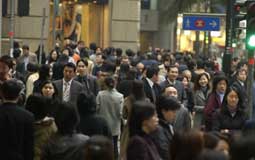
| Hong Kong harmony: Donald Tsang says the proposed population policy should strive to improve the overall quality of the population. |
Chief Secretary for Administration Donald Tsang delivers the Report of the Task Force on Population Policy, which aims to find ways to secure and nurture a population that sustains Hong Kong's long-term economic and social development.
Speaking at the Legislative Council, Mr Tsang said the proposed population policy should strive to improve the overall quality of the population to fulfil the vision of Hong Kong as a knowledge-based economy and world-class city.
"We should aim to redress population aging, foster the concept of active and healthy aging, promote social integration of new arrivals, and, most of all, to ensure the long-term sustainability of our economic growth.
"We believe the achievement of these goals will lead to a steady improvement of the standard of living of our people."
He said the Report covers a wide spectrum of public policies.
"We hope that this exercise will lead to a set of coherent and consistent measures being put in place to achieve the objective of the population policy."
Mr Tsang set up the Task Force in September to develop a population policy as pledged by the Chief Executive last year.
The Task Force comprises the Financial Secretary, eight principal officials and relevant department heads.
Its task is to develop a comprehensive population policy that seeks to achieve and propose a set of policy measures to be adopted in the short to medium term.
Within the six months it is given to work, the Task Force seeks to analyse the main social and economic challenges that demographic trends present and explore a set of practical measures to be taken in the short and medium term to address these challenges.
The need for regular review
"Having worked on this subject, I have come to realise that many factors affecting the demographic conditions in Hong Kong are beyond the control of the Government," Mr Tsang said, adding there were market forces in action and the Government had to respect the choices individuals made.
"We also accept the issues involved will inevitably change."
Above all, Hong Kong is integrating more and more closely with the Pearl River Delta region. This will carry far-reaching consequences on Hong Kong's demographic development as more and more people move across the boundary both to and from the Mainland.
"The continuing review of our population policy is therefore essential."
The Task Force also recommends that there should be dedicated resources in the Government to continue to oversee the population policy, to follow up on the longer-term issues and to review the implementation of the various policy measures regularly.
He said the Report's publication denoted the beginning of a mammoth task.
He appealed to LegCo and the community to support this important exercise, which carries long-term consequences for us and for generations to come.
Addressing population aging and low fertility
Mr Tsang said although Hong Kong has an extremely low fertility rate, he finds it inappropriate for the Government to adopt special policies to promote childbirth.
"However, we consider the current tax deduction for third and subsequent children is out of line with the need to increase our numbers."
The Task Force therefore recommends that the Government consider granting the same level of tax deduction for all a family's children, regardless of number.
The One-Way Permit Scheme is the single most important factor in our demographic growth and composition.
Our population grew by 0.7% last year, only 28% of which was due to net natural increase. Some 72% of growth was generated by the net inflow of people, mostly coming under the One-Way Permit Scheme.
"Given its importance, we reviewed this Scheme. The Government approached Mainland authorities, which administer the scheme, in the course of this exercise."
The Task Force came to the view that, unless our fertility rate rebounds significantly, Hong Kong will be increasingly reliant on inward migration for our population growth.
"We respect the right of family reunion and the Right of Abode conferred by the Basic Law, and we have concluded that the present daily allocation of 60 within the 150 quota for children with right of abode in Hong Kong is appropriate."
The Government has proposed to strictly enforce this daily allocation of 60 children and to allow no other categories of One-Way Permit holders to make use of it.
He said the Government has agreed with the Mainland Authorities that spouses in Guangdong will be allowed to continue to use un-utilised sub-quotas for long-separated families, which at present is 30 per day.
"We expect that this will reduce waiting time for spouses in Guangdong," he said.
"In addition, we will encourage them to take out a Two-Way Permit as soon as they have applied for a One-Way Permit to allow them to become familiar with life in Hong Kong. This will help them make an informed decision on whether to settle in Hong Kong while maintaining strong family connections."
For the time being, the total daily quota of 150 will remain unchanged.
Mr Tsang said the Government will liaise closely with the Mainland authorities on the numbers and category allocation.
He also said if there is evidence that the demand falls, the Government will liaise with Mainland authorities on reducing the quota.
"The main changes to the One-Way Permit Scheme will be put into force subject to agreement and legislation by the Central People's Government."
Fostering positive aging
The size of the workforce will shrink as the prime working age population declines. Steps must be taken to reduce dependency of the elderly and raise their productivity.
"To promote positive aging, we believe that we need to revisit and redefine the notion of retirement and old age. We need to promote a new awareness of the elderly people, not as individuals needing help, but as people having much to offer and wanting to give. This should form the essence of our policy for the elderly."
He said neither the younger generation nor the Government should shy away from shouldering the costs of taking care of our elderly population.
"It is essential for us to look far ahead to find feasible and practical ways to develop a sustainable financial support system for the needy elderly. The Health, Welfare & Food Bureau is now undertaking this task."
Quality improvement
As most new immigrants are admitted for family reunion, the Government cannot, as in the case of skilled immigrants, exclude those without high education or skills.
"We shall continue to provide education, training and skills upgrading programmes to new arrivals of different age groups."
The Government is taking two main approaches to meet the manpower needs of the economy.
(1) To upgrade the general level of education for all; and,
(2) To promote and facilitate skills upgrading and life-long education among the existing workforce.
With the establishment of the Manpower Development Committee, Mr Tsang said the Government will adopt a strategic and co-ordinated approach to manpower planning and development to meet the changing demands of our economy.
"In order that Hong Kong may emerge successfully from this challenging process of economic restructuring, we cannot rely solely on the pool of home grown talent to raise the overall quality of our human capital. Indeed, the quest for talent and skills becomes a primary factor in determining economic success of developed economies around the globe."
Mr Tsang said Hong Kong has to attract the best and brightest from all over the world.
"This includes, of course, the populous and fast-developing Mainland. We will relax admission of Mainland professionals and talent to live and work in Hong Kong."
The present restrictions on specific business sectors and admission of dependent family members will be lifted.
"We will also take active measures to attract more Mainland businessmen to set up business in Hong Kong. These measures, which we intend to implement in July, will allow Hong Kong to enlarge the pool of talent needed to meet the requirements of a knowledge-based economy and enhance the competitiveness of our demographic structure."
Apart from business talent, we will also attract Mainland talent from more diversified fields, such as the arts and sports, as part of building a multi-faceted, world-class city.
He said the Education & Manpower Bureau will implement a series of measures in September to attract more overseas students to pursue their tertiary and postgraduate education in Hong Kong.
"We think that this will help to create a multi‑lingual and multi‑cultural environment at our tertiary institutions. This will also further the essential process of building a critical mass of knowledge and skills that will fortify Hong Kong's status as a world city."
He said the Government will relax the current policy to attract investment immigrants to enhance our economic strength.
"We propose to allow foreign investors to settle here from the second half of this year. This relates to people who have the financial means to make a substantial investment in Hong Kong but who do not wish to run a business."
The Task Force recommended that the threshold should be set at $6.5 million. Prospective applicants will be allowed a reasonable flexibility in their choice of investments. Qualifying asset classes will include real estate and specified financial assets.
The new policy will apply to foreign nationals, and Macau and Taiwan residents. Because of foreign exchange controls, the new policy will not, at this stage, apply to Mainlanders.
"For Mainland businessmen, we propose to encourage them to make greater use of the current multiple visit permit system in coming to Hong Kong to look for investment opportunities."
Mr Tsang said the Government will consider amending the immigration law to allow visitors to engage in a wider range of business-related activities in Hong Kong.
"We believe that these new measures will help generate greater economic activity and in turn more employment opportunities."
Integration and long-term sustainability
Hong Kong has a significant transient population. It consists of imported low‑skilled workers who are allowed to stay in Hong Kong so long as they remain employed.
They currently number almost 240,000, most of them employed as domestic helpers. A much smaller number is mainly admitted under the Supplementary Labour Scheme.
The Task Force considered that several improvements should be made to enhance the integrity of the mechanism of admitting foreign maids with the aim of minimising abuse and displacement of local jobs by domestic helpers.
Since the enactment of the Employees Retraining Ordinance in 1992, employers importing workers other than foreign domestic helpers have been paying a levy.
It is a well-established principle that employers turning to imported workers, rather than local employees, should contribute towards the training and retraining programmes.
At present, only employers under the Supplementary Labour Scheme are required to pay a levy.
"We recommend that the same levy, currently $400 a month, should also apply in the employment of foreign domestic helpers."
This will take effect from October 1.
According to existing arrangements under the Supplementary Labour Scheme, the levy will be paid upfront by the employer and will apply to new contracts and renewal of contracts.
To provide flexibility to employers, the Government will allow an option for the levy to be paid by four instalments, i.e. $2,400 each.
The first instalment should be paid before the granting of a visa to the foreign domestic helper. Employers under the Supplementary Labour Scheme will enjoy the same flexibility.
The Employees Retraining Ordinance also stipulates that if an imported employee fails to arrive in Hong Kong having been granted a visa, or having arrived but fails to complete the contract of employment, there will be no refund of the levy paid, but the Director of Immigration will take into account the relevant balance if a fresh application for an imported employee is submitted within four months.
The Task Force also believes employers of foreign domestic helpers, like employers of other imported workers, should contribute towards the training and retraining of the local workforce.
Along with the significant downward adjustment in various local economic indicators since the last adjustment to the minimum allowable wage for foreign domestic helpers in 1999, the minimum allowable wage for foreign domestic helpers will be reduced by $400 per month for employment contracts signed on or after April 1.
The Labour and Immigration Departments will step up enforcement action against abuse of foreign domestic helpers, such as underpayment and making them perform non-domestic work.
"We hope that these actions will help to prevent exploitation of migrant workers and promote employment opportunities for local domestic helpers."
Mr Tsang also said it has become clear that Hong Kong faces a severe fiscal situation and is running a sizeable deficit.
Many public services in Hong Kong are heavily subsidised and various sectors in the community have expressed the view that the Government needs to take urgent steps to address rising public spending on social and other services, particularly in light of population aging and the continuing influx of new immigrants.
Some of the subsidised services such as public rental housing and social security benefits currently require applicants to meet a certain length of residence in Hong Kong; others such as public health services do not.
Public health services are available not only to permanent and non‑permanent Hong Kong residents, but also to the transient population such as foreign domestic helpers, migrant workers and visitors including Two‑Way Permit holders.
"The Task Force considers that in developing the population policy, the opportunity should be taken to address this anomaly. We have focused our attention initially on the Comprehensive Social Security Assistance Scheme and public health services which together took up 22% of total public recurrent expenditure in 2001/02."
He said they also considered that there is a strong case for applying a uniform seven-year residence rule for providing all heavily subsidised social services and public health and hospital benefits.
Eligibility based on a seven-year residence reflects a resident's contribution towards our economy over a sustained period.
For CSSA, the Director of Social Welfare will have discretionary power to grant the allowance for exceptional cases on compassionate grounds. This measure will take effect from a date to be decided. All current residents will not be affected. Young children will be exempted and the measure will apply only to those aged 18 and above.
We further propose that, in principle, the same residence requirement should apply to users of subsidised hospital and public health benefits.
"We will initially apply it to Two-Way Permit holders and visitors. This will take effect from April 1. For the rest of the affected population, the Health, Welfare & Food Bureau will need to conduct an in-depth study to assess the impact before considering when and how this will be applied to them in the longer term.
"I would like to stress that these measures are to ensure resources are allocated on a rational basis for the provision of benefits to Hong Kong people."
In approaching this complex issue, the Government has to strike a very fine balance between the interests of different sectors and pay due regard to the long-term fiscal balance.
|
