|
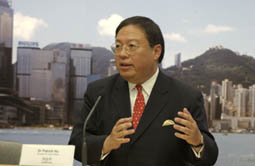
A sure bet: Secretary for Home Affairs Patrick Ho announces proposals to authorise and regulate football gambling. |
The Government has decided to authorise soccer betting as a means of tackling the problem of illegal soccer gambling in Hong Kong.
A bill will be introduced into the Legislative Council in early 2003.
Secretary for Home Affairs Patrick Ho said the Government was hoping that the move would tackle Hong Kong's problem with illegal football gambling.
The Hong Kong Jockey Club with its existing resources and betting facilities has been designated to operate soccer gambling.
Dr Ho said licensing the Jockey Club would also be in line with the existing gambling regulatory regime whereby authorised betting was mainly run by non-commercial and non-profit-making entities.
"The Government plans to issue one licence on soccer betting in Hong Kong, for a period of five years. This seeks to prevent competition amongst operators which could stimulate demand for gambling," he said.
Dr Ho said the Government considered it appropriate and necessary to provide an authorised soccer betting outlet as there had been a large and persistent demand for football punting despite tightened anti-gambling legislation and enhanced enforcement efforts.
He said demand was being satisfied by illegal means which were linked to other criminal activities, and added that the problem could not be fully and practically tackled by law enforcement alone.
Dr Ho said the proposition commanded about 70% support according to the latest public opinion surveys.
"The Government's policy on gambling is to restrict gambling opportunities to a limited number of authorised and regulated outlets only - the underlying rationale is not to encourage gambling," he said.
"The primary objective is to combat the illegal soccer gambling problem. It is intended as a means of tackling an established social problem."
Illegal soccer gambling is invariably associated with other illegal activities, such as loan sharking and debt collection.
It is also one of the major sources of funding for organised and serious criminal activities. Authorisation of it could divert the existing illegal betting to the regulated channel.
"This could alleviate the illegal soccer gambling problem and the Police resources required to counter such activities."
Other proposals for the operational and regulatory framework for soccer betting are:
* The Government will set up an independent special commission which is responsible for the regulation of soccer betting and the Mark Six lottery. This commission will comprise predominantly of non-officials;
* the licensee will contribute to a dedicated fund for public education, providing treatment and counselling services for pathological gamblers, and conducting research on problem gambling;
* the licensee will display notices at gambling establishments informing punters of the risks of gambling, and avenues of seeking assistance in cases of need. Restrictions will be imposed on the promotion and advertising of soccer betting to minimise the effect of encouraging the public to gamble;
* people under 18 will be prohibited from placing bets, entering betting premises and opening betting accounts; and,
* credit betting will be prohibited.
"Our package of proposals seek to strike a balance between the need to combat illegal soccer gambling effectively, and the need to address public concerns about the negative social impact of gambling," Dr Ho said.
The Government will finalise details of the operational and regulatory framework for soccer betting in the coming months, with a view to presenting the necessary legislative amendments to the Legislative Council in 2003.
Revenue-raising is not the main objective of authorising soccer betting. Nevertheless, the imposition of a betting duty on soccer betting would bring in additional recurrent revenue for the Government and help alleviate the budget deficit.
|
