|
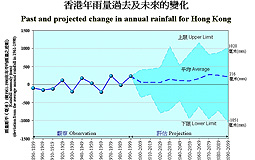
| Wetter weather: The past and projected change in annual rainfall for Hong Kong. |
A recent Hong Kong Observatory study found that under the influence of global warming, annual rainfall in Hong Kong would increase at a rate of about 1% each decade in the 21st century - about the same rate as in the past 120 years.
This is in line with the conclusion the Intergovernmental Panel on Climate Change reached in its 2001 assessment report: As the hydrological cycle intensified in a warmer world, global average precipitation would increase in the 21st century.
Long-term change in rainfall is a factor for consideration in the disaster-mitigation planning.
Under the anticipated increasing rainfall trend, in the last 10 years of this century - from 2090 to 2099 - the average annual rainfall at the Hong Kong Observatory Headquarters would be about 2,430 millimetres, or 216mm more than the 1961-1990 average of 2,214mm.
Hong Kong Observatory's acting Director Yeung Kai-hing said, apart from the overall upward trend, the year-to-year variability in rainfall would also increase in the 21st century.
Heaviest rain recorded in 1997
"In the past 120 years, the highest annual rainfall recorded at the Hong Kong Observatory Headquarters was 3,343mm," Mr Yeung said.
In the 21st century, six years are expected to experience annual rainfall above this figure.
"In the past 120 years, the lowest annual rainfall recorded at the Hong Kong Observatory Headquarters was 901mm. We expect to see three years in the 21st century with annual rainfall less than this," he said.
The highest annual rainfall of 3,343mm was recorded in 1997, a year in which rainstorms triggered severe flooding and numerous landslides in Hong Kong, and forcing the issue of red and black rainstorm warnings on many occasions.
The lowest annual rainfall of 901mm was recorded in 1963. Water rationing was implemented that year, with water supplied to the public once every four days.
Study method
The present study used the results of supercomputer simulations of future climate major climate centres made around the world.
These centres - in the United States, Canada, Britain, Germany, Australia and Japan - had carried out simulations of the future climate including rainfall using global climate models with different greenhouse gas emission scenarios. The results were assimilated into the assessment report of the Intergovernmental Panel on Climate Change of 2001.
The greenhouse gas emission scenarios used in the computer simulations reflected the various assumptions made by experts on the world's future population, economy, technology, energy and land-use patterns.
The Hong Kong Observatory made projections of future rainfall changes in Hong Kong using the results of simulations made by global climate models under the differing emission scenarios together with observed rainfall in Hong Kong, southern China and central China.
Amber rain warnings set to increase
In the 21st century, the number of days with heavy rain is also likely to increase.
Mr Yeung said from the 30-year period from 1961 to1990 to the last 30 years of this century, from 2070 to 2099, the number of days in a year with hourly rainfall exceeding 30mm (the rainfall criterion for issuing the Amber Rainstorm Warning) will increase from five-and-a-half to six-and-a-half.
|
