|
Mainland specialists have critically re-examined more than 37,000 plant specimens at the 124-year-old Hong Kong Herbarium, the longest-running institute of its kind in the region.
This review has enhanced the herbarium's electronic database and improves public access to its rich collection of specimens.
|
|
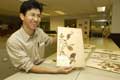
| Plant Conservation: Conservation Officer Dr Yip Kwok-leung shows plant specimens that field workers have collected throughout the territory. |

|
The database will soon be made available on the Internet for easier access by the public, said Agriculture, Fisheries & Conservation Department Officer Dr Yip Kwok-leung.
Dr Yip, the Department's Conservation Officer in charge of flora, said the department is collaborating with the South China Institute of Botany, Academia Sinica. Mainland experts on different plant families had undertaken a comprehensive review of the herbarium's collection.
They have re-examined, identified and verified every plant specimen in the herbarium. The correct scientific name of the species and detailed information about it helps to avoid unnecessary misidentification and misunderstanding of the plant species.
He said the specimens helped us understand more about the local plants.
"If we do not understand a very precious species in a piece of land that is going to be developed, we may lose that particular species once its habitat has been developed," said the 33-year-old biologist, who obtained a PhD in biological sciences at the University of Cincinnati, Ohio.
The Hong Kong Jockey Club injected $4.5 million to sponsor the four-year review, which began in 1998.
The Hong Kong Herbarium was set up in 1878 by the then Superintendent of the Government Gardens & Tree Planting Department, Charles Ford. It is the first public herbarium in China.
The Herbarium started with Mr Ford's personal collections from Hong Kong and South China. Its collection grew gradually, with additions from other countries including Indochina, the Philippines, India and Australia.
To date, the Herbarium houses 37,698 specimens. They can be grouped into about 3,000 species, 2,000 of which are native to Hong Kong. A four-member team under Dr Yip takes care of the collection, updating and maintenance of the specimens.
The herbarium is responsible for the systemic collection, identification and curation of plant specimens of Hong Kong.
"It plays a significant role in supporting the studies on the taxonomy, ecology and conservation of Hong Kong flora.
"Its collection of specimens, associated field notes and botanical literature, also offer good reference materials to botanists," he said.
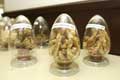
One of its oldest specimens is the common Aquilaria sinensis, a key ingredient in making incense. Hong Kong, which literally means "Fragrant Harbour", takes its name from the incense-making industry which sprang up to take advantage of this prolific plant.
The plant is a rare and protected species in China as a result of excessive exploitation over the years.
The Hong Kong Herbarium has re-discovered some precious plants in recent years.
One example was the Hong Kong Croton which was originally discovered on Hong Kong Island over 100 years ago. An herbarium staff member rediscovered the plant on Tsing Yi island in 1997. It is not easy to observe the croton as it typically grows under ledges.
"It is unique because it is not known outside Hong Kong," Dr Yip said.
Ligustrum was re-discovered in 2001 during botanical surveys in various locations including Sam Chung and Sam Ah Chung. Its re-discovery has enabled Herbarium staff to replant it throughout Hong Kong to ensure its survival in the wild. It had not been seen since 1930.
"The herbarium plays an important role in increasing awareness of the local flora and its conservation in the community by serving as a resource and information centre on the local flora," Dr Yip said.
The specimens reflected the development of Hong Kong, he said.
Many of the localities where the specimens were collected have already been urbanised. For example, Causeway Bay, now a commercial and residential hub, was once home to fields of Aquilaria sinensis.
"It is only through the specimens of the herbarium that we know such plants once existed in the area," Mr Yip said.
The Hong Kong Herbarium is located on the 7th floor of AFCD at the Cheung Sha Wan Government Offices, Kowloon. Individual and group visits to the herbarium can be arranged by appointment.
Go To Top
|