|
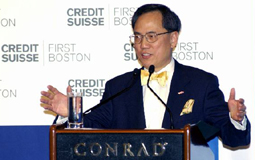
| Success strategies: Donald Tsang outlines Hong Kong's future growth plans. |
At the opening of the CSFB Asian Investment Conference today, the Chief Secretary for Administration reiterated there are no plans to change Hong Kong's linked-exchange rate.
At the podium, Donald Tsang picked up where he left off five years ago when, as Financial Secretary, he addressed the first CSFB Asian Investment Conference, in 1998.
"Those who may have been here in 1998, or have subsequently visited us, will have noticed quite significant changes in Hong Kong over these past five years," he said. "Hong Kong International Airport and all the magnificent infrastructure servicing it are the most noticeable additions to our cityscape."
The substantial investment in the airport was well worth it, he added, since Hong Kong is seeing record numbers of passengers and flights, and world record throughput of international air cargo.
Strategies for success
Hong Kong survived the Asian financial crisis - and picked up a sizeable equity portfolio in the process, Mr Tsang noted. "Those who doubted our intentions at the time will see that we did what we promised - disposed of the shares in an orderly manner that did not disrupt the smooth functioning of the stock market."
He noted that the currency-board system has been strengthened and made more transparent. Financial markets have undergone reform.
"Just last week, we announced major plans to improve stockmarket listing regulations. We have deregulated the banking and telecoms sectors, and encouraged the development of innovation and technology as new economic drivers."
Introducing the Mandatory Provident Fund has provided workers with retirement protection and boosted the fund-management industry, too, he said.
Asia's world city
Significant strides have been taken to improve the living environment, including the launch of Brand Hong Kong, a long-term programme to promote the strengths and advantages that underpin Hong Kong's positioning as Asia's world city.
"We are acutely aware that we can never afford to stand still," he stressed. "We want our market to be innovative and progressive, because that has a direct bearing on our attractiveness as an investment destination."
Hong Kong's markets must be kept free and open - with no capital controls, a low and simple taxation system, the absolute free flow of information. A tried and trusted legal framework and a stable currency regime provides investors with a greater deal of certainty, he said.
He reiterated that there are no plans to change Hong Kong's linked exchange rate under the currency-board system.
"We will always strive to provide a quality market environment in terms of products, services and regulatory system. And we must be a place of opportunity, that magic ingredient that has made Hong Kong what it is today - and will continue to attract investors to Hong Kong in the years ahead."
Overcoming challenges
The past five years have been rather tough for Hong Kong, Mr Tsang said. It has been grappling with painful economic restructuring due to the bursting of an asset-price bubble, the advent of the knowledge-based economy, and the rapid opening up and development of the Mainland market.
"This has led to a large drop in the personal wealth of many people in Hong Kong, a prolonged period of over 50 months of deflation, high unemployment, low levels of consumer confidence and an uncomfortably high fiscal deficit."
The plus side is that the drop in asset values and deflation has made Hong Kong a much more competitive economy, he said.
Reviving the economy will help to address three of Hong Kong's biggest domestic concerns: deficit, deflation and unemployment.
"Given the right environment and encouragement, we can stimulate the market to lead the way," Mr Tsang said.
"I do not mean that we will be picking winners in various sectors of the economy. We simply want to make it as easy as possible for the private sector to do well, and to make the most of the significant opportunities we offer as an economy in our own right, as a strategic two-way platform for the Pearl River Delta, and as an international financial centre for China and the Asia-Pacific Region."
Economic planning
The 2003-04 Budget released earlier this month contained a number of initiatives that should make Hong Kong a more attractive financial market.
* Hong Kong will exempt offshore funds from profits tax, bringing its market in line with London and New York.
* It will exempt the fixed stamp duty on subscriptions to, and redemptions of, Hong Kong domiciled unit-trust funds.
* To promote bond-market development, it will grant a 100% concession on profits tax for qualified debt instruments with a maturity period of seven years or more. Those with a maturity of three years or more will be eligible for a 50% profits-tax concession.
Hong Kong has also been encouraging public-sector bodies such as the Hong Kong Mortgage Corporation, the Airport Authority, the KCRC and the MTRC to come to the bond market.
This will deliver new and continuous liquidity, and provide private-sector issuers with a receptive environment to launch their own issues.
Mainland opportunities
The Government hopes to finalise the main parts of a Closer Economic Partnership Arrangement with Mainland authorities in June, Mr Tsang said.
This is expected to give Hong Kong businesses access to the Mainland market on top of China's WTO commitments.
In any case, there will be significant opportunities in China over the next four to five years in sectors where Hong Kong has a strong edge, he noted. These include financial services, transport, logistics and distribution, professional services, marketing and management.
He outlined other Mainland opportunities:
* As long as China maintains a closed-capital account, much of the Foreign Direct Investment going into the Mainland - and last year that was about US$53 billion - will be serviced through Hong Kong.
* Hong Kong is actively encouraging Mainland enterprises to use Hong Kong as a fund-raising centre.
Last year, about US$9 billion was raised in new listings of H-shares and red chips in Hong Kong. The Mainland's moves on the Qualified Domestic Institutional Investor scheme will allow approved Mainland investors to participate in Hong Kong's markets in a regulated manner.
* An agreement has been reached with the China Government Securities Depository Trust & Clearing to establish a link that will enable authorised Mainland financial institutions to hold and settle debt securities in Hong Kong.
Future initiatives
Hong Kong is pushing ahead with other initiatives to facilitate new products and services, including a 'Trust Fund Passport System' that will allow selected trust funds registered in one country to be marketed in another, without having to re-register.
Others, Mr Tsang said, are Real Estate Investment Trusts, and index-tracking Exchange Traded Funds. In recent months, he noted, we saw the marketing and sale of retail hedge funds for the first time in Hong Kong.
"There is much happening in other sectors that will increase our attraction as a place to live and work, attract new business and create jobs," he said.
"The Cyberport and the Science Park have come on stream and will provide a new focus to the development of innovation, technology and the creative industries. Within the next three to five years we'll have Hong Kong Disneyland and a new cable-car attraction on Lantau Island."
New entertainment and tourist areas will be developed at the old Central Police station, the Marine Police Headquarters and along the harbourfront. A new lighting scheme will make the night view of Hong Kong's harbour even more breathtaking.
A new convention centre is to be built at the airport. Work will have started on Hong Kong's own 'West End' with a Broadway skyline - the new arts and cultural district in West Kowloon.
The living environment will improve further as more new railways come on-line between now and 2007, further reducing reliance on motor-vehicle transport and reducing the air-pollution levels.
"We will continue to invest heavily in education and retraining to provide the intellectual capital needed in a knowledge-based economy, as well as new skills for those who find themselves out of work," Mr Tsang said.
Integration with the Pearl River Delta
There will be increasing economic co-operation between Hong Kong and the rest of the Pearl River Delta, "one of the most dynamic economic regions in the world."
The Delta, he said, gets about 30% of all foreign direct investment into China, and it represents a burgeoning consumer market of almost 50 million people, who have the highest per capita GDP in the country.
It is home to about 7,500 large foreign manufacturing enterprises and tens of thousands of smaller and medium-sized establishments employing millions of people.
The Government is working closely with its counterparts in Guangdong province to leverage Hong Kong's strengths - including its international business and management expertise and support services, coupled with a huge concentration of world-class manufacturing and sourcing operations in the Delta.
Hong Kong will work with its partners in the Delta to undertake joint promotions overseas to attract international companies to set up offices in Hong Kong, and manufacturing or sourcing operations across the boundary.
Infrastructure investment
New road and rail links, greater use of new technology, co-located Customs facilities, and improved visa procedures will greatly smooth the flows of people and cargo between Hong Kong and the Delta, Mr Tsang said.
"In all that we do," he added, "we will maintain our political autonomy and way of life under 'One Country, Two Systems'. Our difference is our advantage"
Hong Kong will continue to play a vital role in China's development. "Our international outlook, legal system, convertible currency, financial services expertise, and intellectual property protection are drawcards not only for overseas corporations, but also for Mainland enterprises," he said.
Hong Kong remains the largest external investor in the Mainland - with cumulated investments of over US$205 billion, or about 46% of all realised direct investment in the Mainland.
Hong Kong enterprises invested about US$19 billion in the Mainland last year alone, Mr Tsang said, noting that many shimmering new office blocks or residential towers in Shanghai or Beijing, or closer to home in Shenzhen or Guangzhou, have been built or financed by Hong Kong entrepreneurs or companies.
"As our country continues to open up, the investment footprint of Hong Kong enterprises will become bigger and more diverse, with significant new opportunities in the services sectors," he added.
Regional powerhouse
The Government has set a goal to be Asia's world city, and already more than 3,100 international companies have regional operations in Hong Kong. There are ongoing efforts to attract even more multinationals and small and medium enterprises here.
Hong Kong's international banking sector leads the region, Mr Tsang said. "Our investment environment is continually under review and being improved."
The airport and port facilities have significant capacity to grow in tandem with expected increases in trade to and from the Mainland, and the tourism sector will benefit greatly from new attractions over the next few years.
"We are developing and promoting our creative industries, to make Hong Kong a capital of culture, as well as a capital of capital," he said.
"All of this is happening to make Hong Kong the best place in Asia to live and work; to reinforce our position as a hub, a facilitator and integrator for the PRD; and, to generate the economic activity needed to help us beat our Budget deficit and to create more jobs for our people."
He urged the audience to share his faith in Hong Kong's future, and to keep an eye on this city, because "the best is yet to come".
|
