Under construction:
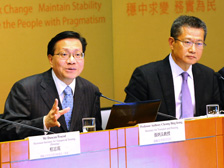
Secretary for Transport & Housing Prof Anthony Cheung (left) and Secretary for Development Paul Chan brief the media on housing and land supply initiatives in the 2013 Policy Address.
Under construction:
Secretary for Transport & Housing Prof Anthony Cheung (left) and Secretary for Development Paul Chan brief the media on housing and land supply initiatives in the 2013 Policy Address.
Artificial island mooted to address housing needs
January 17, 2013
To help build up an abundant land reserve to improve people’s living space, the Government is exploring building an artificial island outside Victoria Harbour, Secretary for Development Paul Chan said.
He and Secretary for Transport & Housing Prof Anthony Cheung briefed the media today on housing and land-supply initiatives in the 2013 Policy Address.
To meet society’s housing demands in the short to medium term, Mr Chan said the Government will implement 10 measures to increase land supply.
This includes a proposal to reclaim 600 hectares of land outside the harbour, in North Lantau, Lung Kwu Tan in Tuen Mun, Southwest Tsing Yi, and Ma Liu Shui near the estuary of Shing Mun River.
The Government is studying an area in the waters between Hong Kong and Lantau Islands, to see whether it is suitable for the proposed artificial island.
Mr Chan said the Government will begin stage two public engagement and conduct planning, environmental and feasibility studies on the selected sites.
Other measures to increase supply include exploring the feasibility of developing a modern new town of about the same size as the Fanling/ Sheung Shui new towns, he said.
Mr Chan said the Government is also studying a proposal to relocate three facilities - the Diamond Hill Fresh Water & Salt Water Services Reservoirs, Sai Kung Sewage Treatment Works and Sham Tseng Sewage Treatment Works - to rock caverns.
He said relaxing or lifting the administrative moratorium in Pok Fu Lam and the Mid-Levels to build residential units is also under consideration. The move would not have a great impact on traffic as the railway expansion will alleviate island traffic jams, he said.
Prof Cheung said a supply shortage is at the crux of Hong Kong’s housing problems, and the Government is committed to increasing public and subsidised housing supply in the coming years.
Under the Housing Authority’s public housing construction programme, he said 75,000 public rental housing units would be completed in the next five years, an annual average of 15,000 new units.
To meet the increase in demand for public rental housing, he said the Government will take steps to boost the land supply. In the five-year period starting from 2018, it has set at least 100,000 public rental housing units as a production target.
The Government cannot move the date forward as it takes time to build the flats, including town planning, consulting stakeholders and design and construction, Mr Cheung added.
Prof Cheung has reiterated the housing policy objectives are to accommodate grassroots families in public rental housing; to assist the middle class in home ownership; to build a progressive housing ladder; and to maintain the healthy and steady development of the private property market, with priority given to Hong Kong permanent residents.