Blue-sky blueprint:
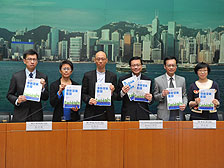
Secretary for the Environment KS Wong (third left) introduces “A Clean Air Plan for Hong Kong”.
Blue-sky blueprint:
Secretary for the Environment KS Wong (third left) introduces “A Clean Air Plan for Hong Kong”.
Gov’t unveils clean air plan
March 28, 2013
The Environment Bureau unveiled measures today to improve air quality, which will see government agencies work together to achieve new Air Quality Objectives by 2020.
“A Clean Air Plan for Hong Kong” covers measures to tackle air pollution from power plants, land and sea transport, and non-road mobile machinery, and to strengthen collaboration between Hong Kong and Guangdong to deal with regional pollution.
Chairing the press conference, Secretary for the Environment KS Wong said the Government has accorded top priority to improving air quality, as a matter of public health.
Mr Wong said the plan’s effectiveness depends on inter-departmental efforts and community involvement, especially from the transport, power and construction sectors.
To reduce air pollution and lower public health risks, the Air Pollution Index will be replaced in 2014 with the new health-based Air Quality Health Index (AQHI) to better reflect air pollution health risks, as supported by the World Health Organisation.
Under Secretary for the Environment Christine Loh said the use of the AQHI and the tightening of New Quality Objectives will result in the number of hours of air pollution being rated as ‘high’ or ‘very high’ will substantially increase, even with no material change in pollutant concentrations.
Ms Loh said this will not mean air quality has worsened, as the new index is meant to provide the public with more accurate information to make daily plans.
Secretary for Transport & Housing Prof Anthony Cheung said his bureau has been working closely with the Environment Bureau on initiatives to improve air quality. These include bus route rationalisation, encouraging public transport operators to enhance their environmental performance, and conducting public consultations on improving traffic distribution among harbour crossings.
The Government will also continue to implement international standards on emissions of ocean-going vessels through local legislation, he said.
The Department of Health will monitor the latest scientific evidence on the health impact of air pollution, particularly advice from the World Health Organisation, and will provide professional advice on health and public hygiene.